
What this project is about.
This one is from Book 9.
How long it took to read this (aloud): 14 mins 01s
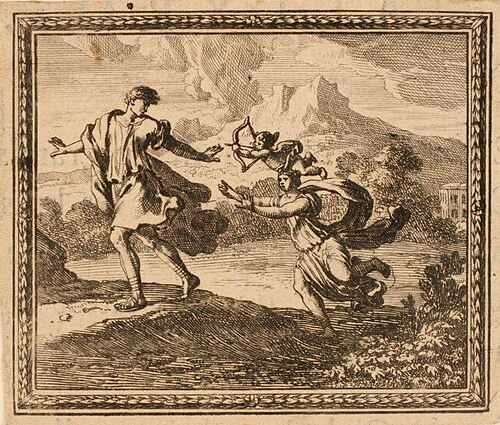
What it’s “about”: Byblis has the horn (I mean, the HORN) for her brother. He says nope, and flees to build a city. She pursues him, goes mad, is eventually turned to tears.
Words I didn’t know:
Thyrsus (again) In Ancient Greece a thyrsus (/ˈθɜːrsəs/) or thyrsos (/ˈθɜːrsɒs/; Ancient Greek: θύρσος) was a wand or staff of giant fennel (Ferula communis) covered with ivy vines and leaves, sometimes wound with taeniae and topped with a pine cone, artichoke, fennel, or by a bunch of vine-leaves and grapes or ivy-leaves and berries, carried during Hellenic festivals and religious ceremonies.[1][2] The thyrsus is typically associated with the Greek god Dionysus (and his subsequent Roman equivalent Bacchus) as a symbol of prosperity, fertility, and hedonism.[3]
Ilex Ilex aquifolium, the holly, common holly, English holly, European holly, or occasionally Christmas holly, is a species of flowering plant in the family
Quotable quotes:
When Byblis fell in love (That is a story
Of how girls should not fall in love at all)
She had immoderate heat for her twin brother,
The fair and glittering grandson of Apollo.
At first she did not think such heat was love.
Although her greatest pleasure was to play
A game at kissing him, her arms around his neck,
She thought these gestures sisterly affection.
Slowly these careless pleasures turned to fire;
AND
Yet all these signs of how she felt were vague;
She could not read them clearly, nor admit
These were the wavering joys of love itself,
That hidden fires glowed within her blood.
And
With trembling hand she wrote what impulse guided;
Right hand held stylus, left, the sheet of wax.
She wrote, then stopped, then shocked at what she wrote,
Erased, began again, crossed some words out,
And hoped to find the right ones, stopped, then threw
Her tablets to the floor, then picked them up,
She doubting everything she wrote, or right
Or wrong, or spelled correctly, her face flushed
With guilt, yet mouth set firm. She had just written “sister,”
Then crossed it out and wrote, “Good wishes, darling,
If you return them, they are mine; if not,
I’ll take them anyway, to keep them for you —
Yet know that they are yours from one who loves you.
AND
Meander’s grandson
Glanced down the sheet and threw it to the floor,
Red with his fury smashed the servant’s face.
“Run like a fool before I cripple you,
You Goddamned idiot and pimp— get out!”
AND
I should have tested him with double-talk;
Waited in harbour till the wind blew fair,
Then reefed my sails and steered a course to shelter.
Full-bellied, I sailed mto unknown winds,
Torn on the rocks, wrecked, floundered, lost
In storms of ocean where no shores return.
And
Beyond this forest mountain range she ran,
Till spent, she fell — O Byblis! — face to earth,
Half buried on a plot of stones and leaves.
The girls who guarded native streams and rivers
Then tried to lift her up, to carry her,
To tell her hopeless love could be dispelled.
She lay unheaRIng, careless where she fell,
Tore at pale grasses, watered them with weeping.
(Some say the naiads filled her veins with tears —
What else had they to give to cool disorder?)
As sap runs from the sides of new cut pine,
Or tar spurts from a fissure of hot earth,
Or west wind floating under April’s sun
Turns ice to water in a frost-bound well,
So all of Byblis melted into tears,
And is that fountain in a distant valley,
A stream that has her name, that rises, falls,
And flows beneath a dark-leaved ilex tree.
How it lands to my eco-sensibility: xx
Obvious allusions, ways it was used (that I am aware of already) : xx
What I know I didn’t ‘get’: xx
To my knowledge, who’s used it why/how (RACC): xx
Further research questions: xx
Anything else: xx
Want to read this –
“THE LABYRINTH AND THE MIRROR”: INCEST AND INFLUENCE IN “METAMORPHOSES” 9
MICAELA JANAN
Arethusa Vol. 24, No. 2 (Fall 1991), pp. 239-256 (18 pages)
https://www.jstor.org/stable/26309405
“Bibi had the horn for her brother
In her lust she could see no other
She wrote him a letter
His reply it upset ‘er
Of a fountain she became the mother.”


Leave a Reply