
What this project is about.
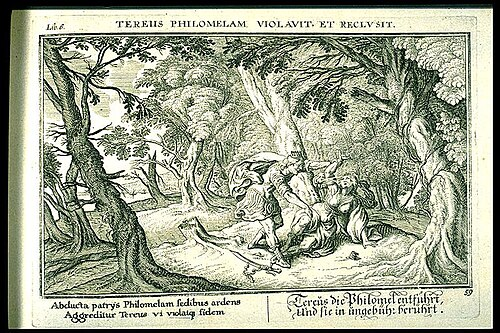
This one is from Book 6.
How long it took to read this (aloud): 18 mins 56s
What it’s “about”: Tereus wins a war and this, well – explanation would add up to excuses for astonishing behaviour. His wife, Procne wants either to visit her sister (Philomela) or have her sister comes visit. Tereus goes to fetch Philomela, then on the way back kidnaps, rapes and mutilates her (cuts out her tongue). Philomela gets a loom and some wool, makes a “this is what happened, come get me” tapestry, which is delivered to Procne by an old woman. Procne and Philomela are mildly upset, and use Procne’s five year old son as revenge. Procne kills him, bake him and feeds him to Tereus, then tells Tereus what he just ate. Tereus is miffed. Everyone gets turned to birds.
Words I didn’t know: Noun scritch (plural scritches) A light scratching sound, like a small animal burrowing. The act of scratching an itch. The act of petting an animal or human .
Quotable quotes: xx
Tereus was in flames — the kind of fire
That sweeps through corn, dry leaves, or autumn hay
Heaped in a barn. Of course the girl was worth it,
But all his natural passions drove him on;
Men of his country were well known for heat —
Their fire took root within him as his own.
And
Love made him quick of speech,
And when he talked too fast, too eagerly,
He said he took instructions from his wife
And at her inspiration begged and wept
Great gods! What darkness fills the human heart!
And
he, like Jove’s eagle
When the bird has clawed then dropped a shrinking
Rabbit in a high nest and the spent creature
Has no chance of an escape — Tereus gazed,
And gloried at the prospect of his feast.
And (various trigger warnings)
Her neck to meet the blow, to welcome death;
Instead he thrust sharp tongs between her teeth,
Her tongue still crying out her father’s name.
Then as the forceps caught the tongue, his steel
Sliced through it, its roots still beating while the rest
Turned, moaning on black earth, as the bruised tail
Of a dying serpent lashes, so her tongue
Crept, throbbed, and whimpered at her feet. This done
The tyrant (it was said; we scarce accept it)
Renewed his pleasure on her wounded body.
And
And misery generates a subtle shrewdness.
And
When Philomela saw where she had come,
The house of curses and of nameless sins,
The luckless girl went white with shock and horror.
Then Procne found a room to quiet her,
Unwound the vines that hid her guilty face,
And
“Now is no time for tears, we need
Good steel, something that has a bolder strength
Than iron, and with a keener edge, my dear.
This is my day for crime, to take a torch
To all rooms of the palace, to push Tereus,
Who made us what we are, into its flames,
Or clip away his tongue, tear out his eyes,
Cut off the genitals that injured you —
And then still gaping with a thousand wounds
Whip from that body breath of its damned soul.
My heart is fixed upon some major plan,
But what or where I’m still of several minds.”
And
And no more words — she caught up
Itys, and as a tigress carries off
A poor teat-sucking fawn down the deep forests
Of the Ganges’ side, so she took Itys,
Far to a lonely room of the huge palace.
The boy saw death within his mother’s face
And screamed, “O mother, mother!” reached his hands
As though to throw his arms around her neck,
And Procne, with no change of eyes or feature,
Ran a quick knife below his beating breast.
The boy died with one thrust, but Philomela
Stabbed through his throat; the body warm, still breathing,
Was cut and pared- some pieces turned on spits,
Others boiled in a pot. The room ran blood.
And
“Bring Itys here,” he called; and she, bright with
Mad joy to be the first to let him know
His fate, cried out, “You have the boy inside.”
Again he turned to ask her where he was,
And as he called a third time, Philomela,
Spotted with blood of Itys, her wild hair
Flying, leaped up to him, tossing the boy’s
Blood-dabbled head into his face: at no time
Had she the greater need for words of joy
She felt at serving him. Then with a cry
The Thracian tyrant kicked away the table,
And hailed the snakehaired Furies from Hell’s pit.
AND
How it lands to my eco-sensibility: xx
Obvious allusions, ways it was used (that I am aware of already) : Well, obviously Titus Andronicus. But lots of others – the Wikipedia page for Philomela outlines some of the ways.
What I know I didn’t ‘get’: xx
To my knowledge, who’s used it why/how (RACC): xx
Further research questions: xx
Anything else: xx


Leave a comment