
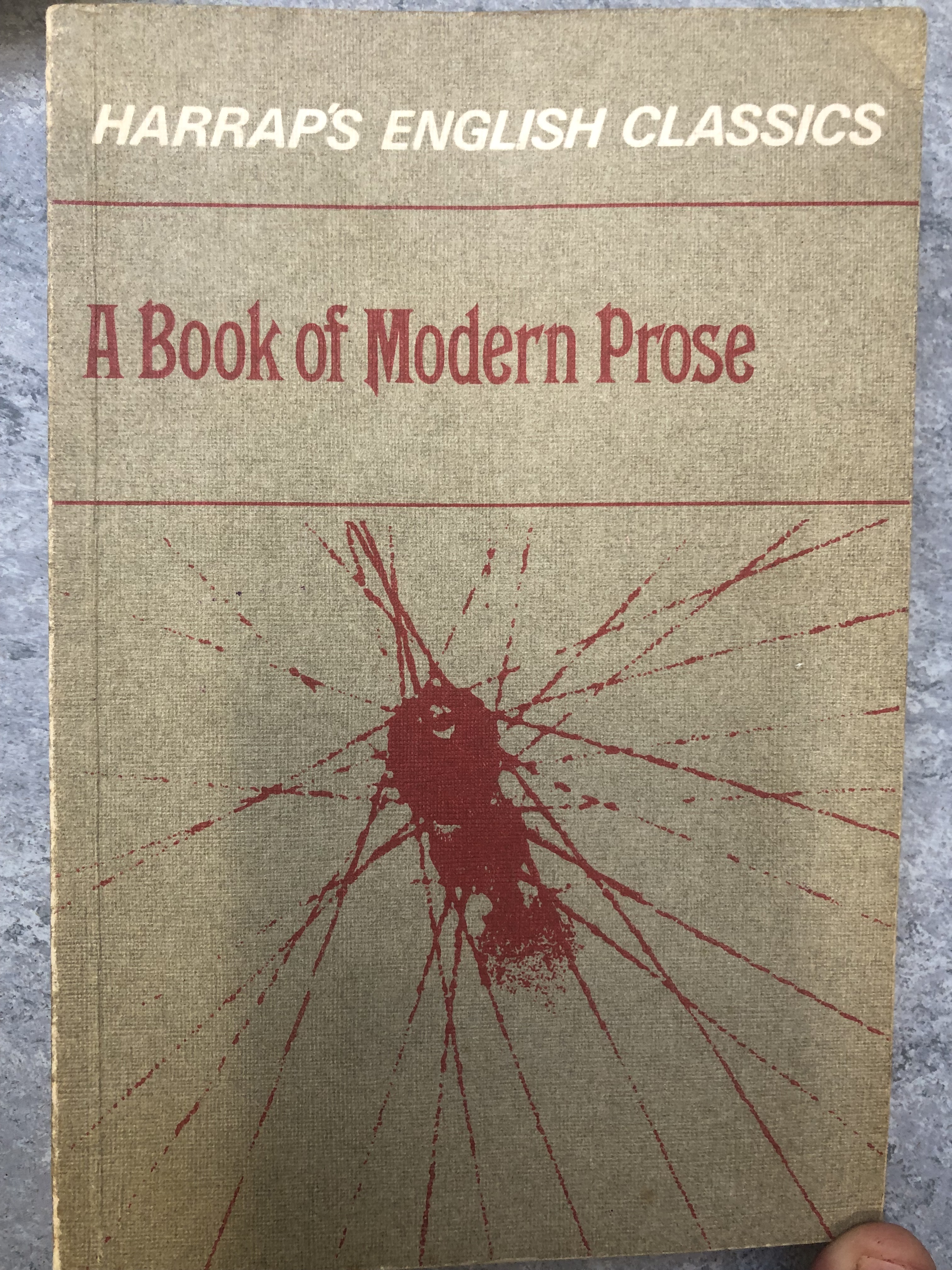
I bought this – Harrap‘s English Classics: A Book of Modern Prose – for a quid in Stone recently. I read a section a day for just over two weeks. I was going to blog as I went: I wrote the blogs but was too idle/busy to post.
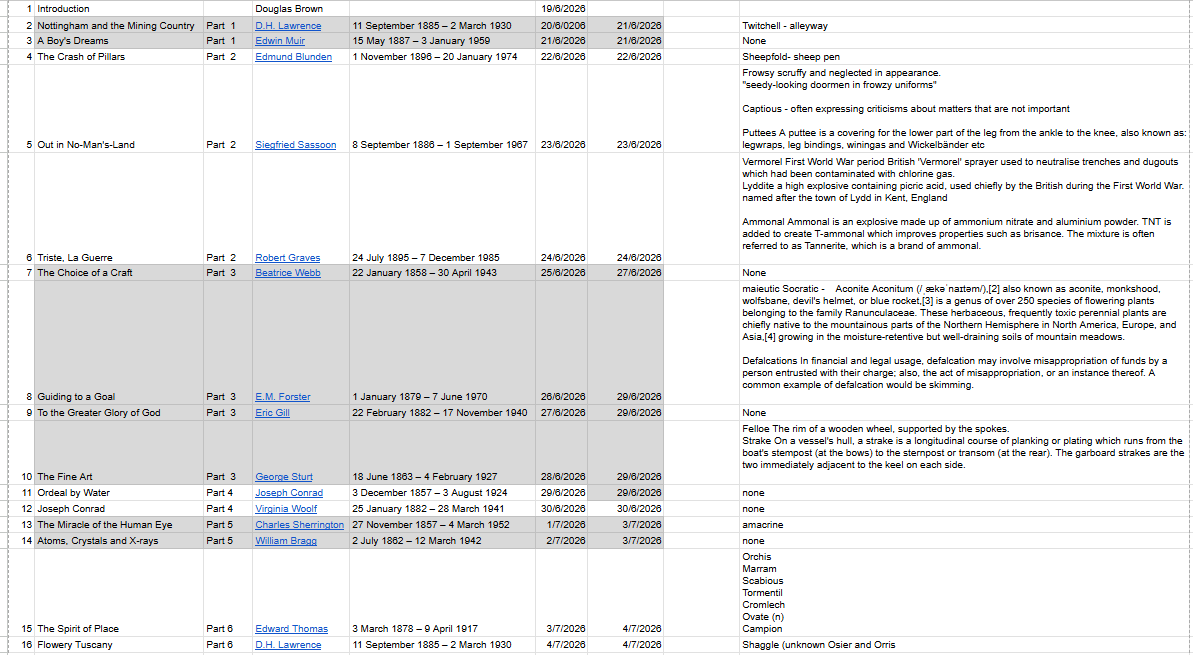
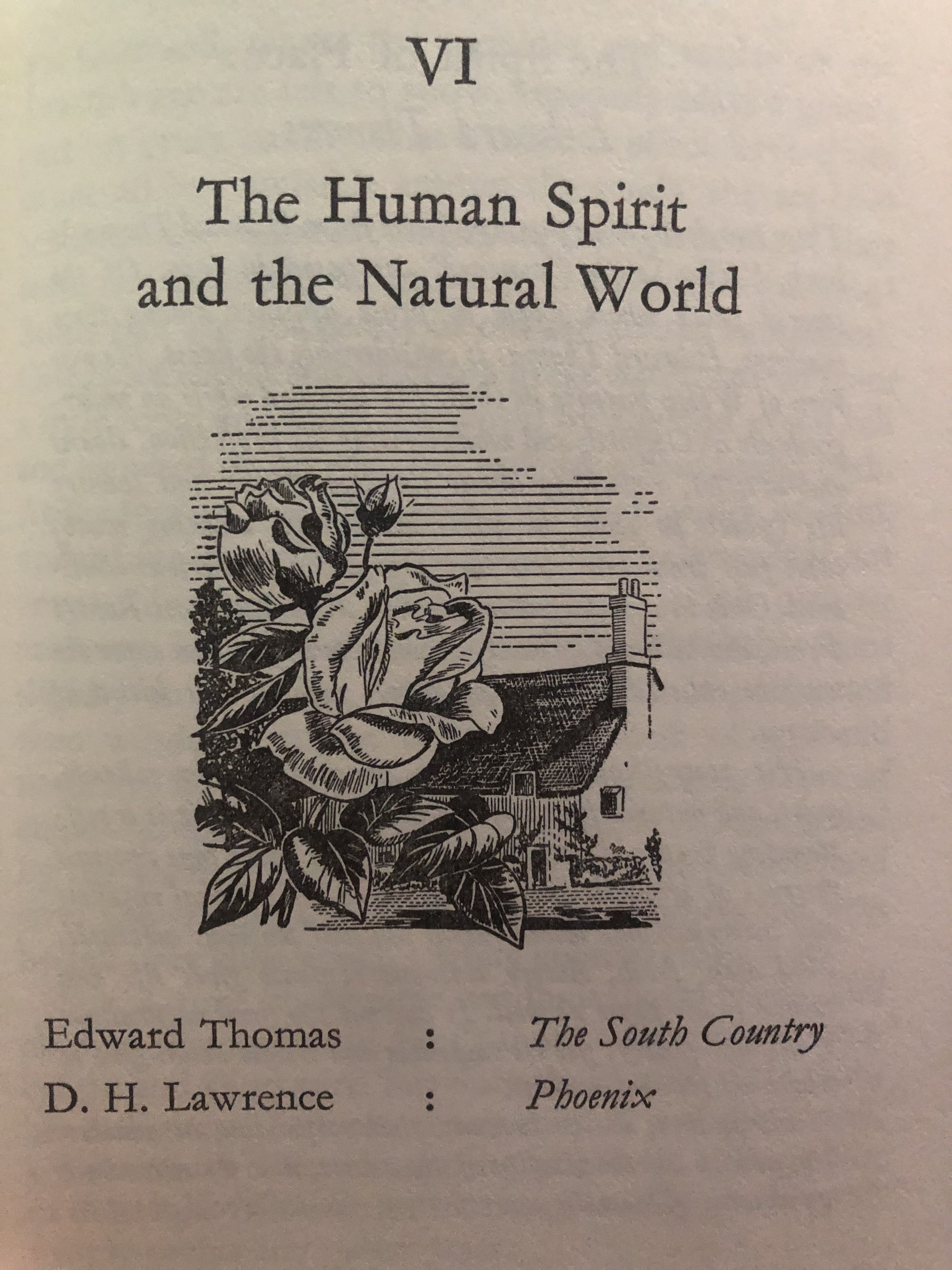
Tl;dr – this was a very nice collection. Male-dominated, of course (only two women, and one of them – Virginia Woolf – writing about a man (Joseph Conrad). What struck me was
a) how astonishingly nightmarish the Western Front was (I know, I know, and I knew, but, oh my).
b) how much of the natural world we have lost in the course of the 20th and 21st century (see Thomas and Lawrence at the end)
c) the skills and sensibilities we lost too. I am not saying the 19th century was a barrel of laughs, but still…


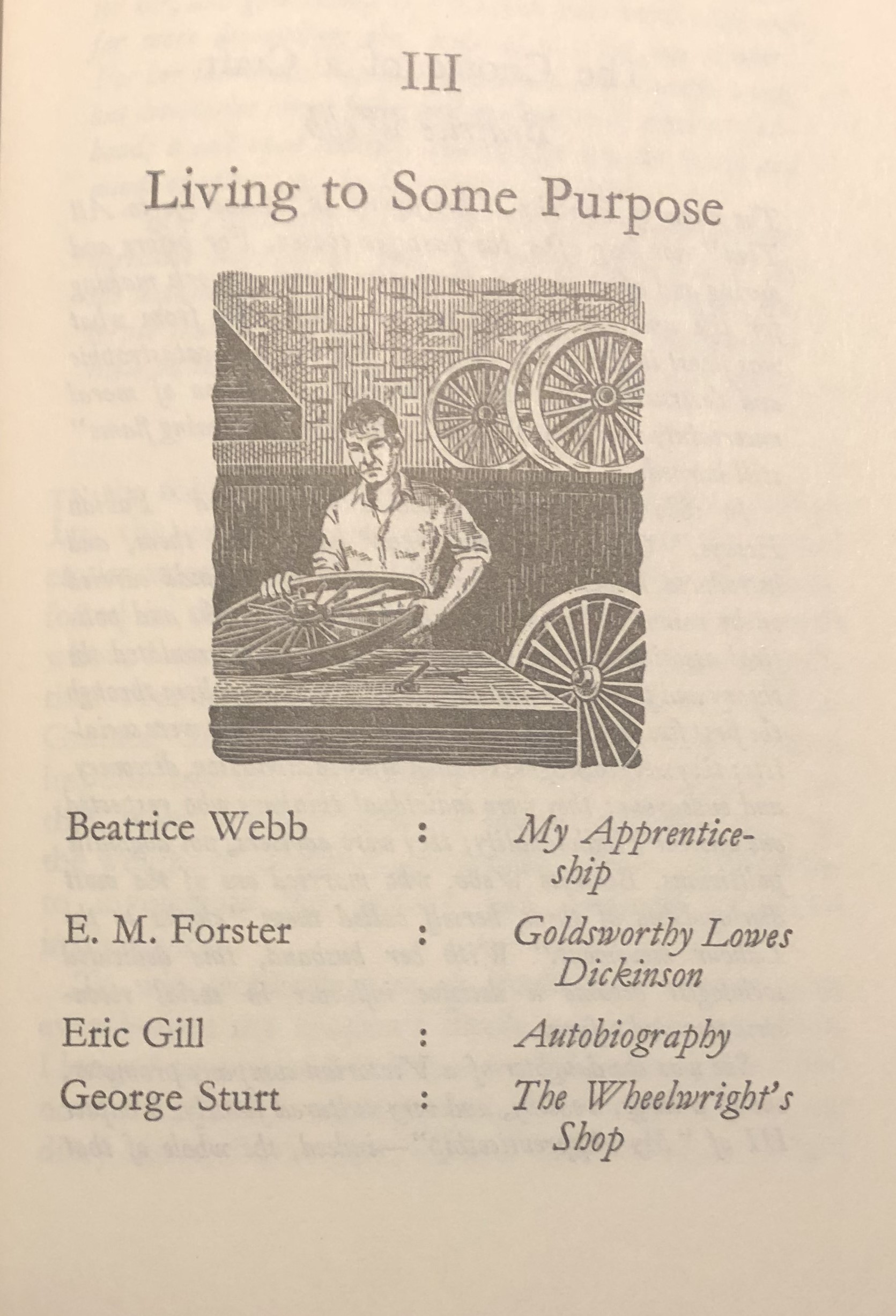


Anyhoos, lots of words for my vocabulation spreadsheet-
Twitchell – Nottingham word for alleyway
Sheepfold – a sheep pen.
Frowsy scruffy and neglected in appearance “seedy-looking doormen in frowzy uniforms”
Captious – often expressing criticisms about matters that are not important
Puttees A puttee is a covering for the lower part of the leg from the ankle to the knee, also known as: legwraps, leg bindings, winingas and Wickelbänder etc
Vermorel First World War period British ‘Vermorel’ sprayer used to neutralise trenches and dugouts which had been contaminated with chlorine gas.
Lyddite a high explosive containing picric acid, used chiefly by the British during the First World War. named after the town of Lydd in Kent, England
Ammonal Ammonal is an explosive made up of ammonium nitrate and aluminium powder. TNT is added to create T-ammonal which improves properties such as brisance. The mixture is often referred to as Tannerite, which is a brand of ammonal.
Maieutic – of or denoting the Socratic mode of inquiry, which aims to bring a person’s latent ideas into clear consciousness.
Aconite Aconitum (/ˌækəˈnaɪtəm/),[2] also known as aconite, monkshood, wolfsbane, devil’s helmet, or blue rocket,[3] is a genus of over 250 species of flowering plants belonging to the family Ranunculaceae. These herbaceous, frequently toxic perennial plants are chiefly native to the mountainous parts of the Northern Hemisphere in North America, Europe, and Asia,[4] growing in the moisture-retentive but well-draining soils of mountain meadows.
Defalcations In financial and legal usage, defalcation may involve misappropriation of funds by a person entrusted with their charge; also, the act of misappropriation, or an instance thereof. A common example of defalcation would be skimming.
Felloe The rim of a wooden wheel, supported by the spokes.
Strake On a vessel’s hull, a strake is a longitudinal course of planking or plating which runs from the boat’s stempost (at the bows) to the sternpost or transom (at the rear). The garboard strakes are the two immediately adjacent to the keel on each side.
Amacrine – In the anatomy of the eye, amacrine cells are interneurons in the retina.[1] They are named from Greek a– ‘non’, makr– ‘long’ and in– ‘fiber’, because of their short neuronal processes. Amacrine cells are inhibitory neurons which project their dendritic arbors onto the inner plexiform layer (IPL). They interact with retinal ganglion cells and bipolar cells.[2]
| Orchis | Orchis Orchis is a genus in the orchid family (Orchidaceae), occurring mainly in Europe and Northwest Africa, and ranging as far as Tibet, |
| Marram | Marram The dense, spiky tufts of Marram grass are a familiar sight on our windswept coasts. In fact, its matted roots help to stabilise sand dunes |
| Scabious | Scabious Scabiosa /skeɪbiˈoʊsə/ is a genus in the honeysuckle family (Caprifoliaceae) of flowering plants |
| Tormentil | Tormentil a low European plant, Potentilla erecta, of the rose family, having small, bright-yellow flowers, and a strongly astringent root used in medicine and in tanning and dyeing. |
| Cromlech | Cromlech A cromlech (sometimes also spelled “cromleh” or “cromlêh”; cf Welsh crom, “bent”; llech, “slate”) is a megalithic construction made of large stone blocks. The word applies to two different megalithic forms in English,[1][2] the first being an altar tomb (frequently called a “dolmen“), as William Borlase first denoted in 1769.[3] A good example is at Carn Llechart [cy].[4] The second meaning of the name “cromlech” in English refers to large stone circles such as those found among the Carnac stones in Brittany, France.[2][1] |
| Ovate (n) | Ovate (n) Vates (Celtic: *wātis ‘seer, sooth-sayer’; Greek: ouáteis, οὐάτεις)[1][2] were a class of seers and sacrificers among the ancient Gauls. Greek and Roman writers describe them as one of three specially honoured groups in Gaulish society, ranked beside the bards and the druids.[3] They conducted sacrifices, foretold the future, and concerned themselves with the natural world.[4] The account goes back to the lost Gaulish ethnography of the Greek philosopher Posidonius. It survives in three later writers, Diodorus Siculus, Strabo and Ammianus Marcellinus, who name and describe the class in terms that do not fully agree.[5] The native word behind the Greek and Latin forms is reconstructed as Proto-Celtic *wātis, also continued by Old Irish fáith (‘seer, prophet’).[6] |
| Campion | Campion Can also be known as Red Catchfly, A plant which can grow to around 1m tall, red campion fills woodlands and roadside verges with a warming dash of pink colour during the spring and summer. Available in many flowered varieties, red campion is a perennial flower with rose-pink flowers and green leaves that prefers dappled shade. Seed capsules drop to form separate plants and can spread quickly. Well-suited to a moist wildflower meadow or other moist environments that offer shade. |
| Pewit | Pewit – northern lapwing |
| Oast | Oast – a kiln used for drying hops. |
| Bryony | Bryony – Small, yellow-green flowers appear in early summer, followed by conspicuous strings of shiny, red berries that often remain throughout autumn |
| Shaggle | Shaggle – unclear what this means! |
| Osier | Osier The Common osier is a small willow tree that is found in fens and ditches, and on riverbanks. It has been widely cultivated and coppiced for its twigs. |
| Orris | Orris Orris root (Rhizoma iridis; is the root of Iris germanica and Iris pallida. It had the common name of Queen Elizabeth Root. |
I plan to blog about particular excerpts I typed up, that seem to me to be worth sharing/pondering/chewing on. Bet you cannot wait!


Leave a Reply