
What this project is about.
This one is from Book 13.
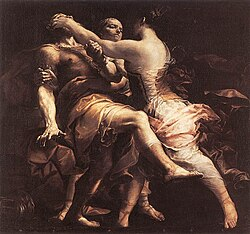
Hecuba Blinding Polymestor by Giuseppe Crespi
“And at a single leap scratched out his eyes.
Her furies gave her supernatural strength;
Her bloodstained fingers thrust holes in his head
Where once his eyes had been.”
This one is from Book 13.
How long it took to read this (aloud): 6 mins 15s
What it’s “about”: The lamentations! War is no fun. Revenge has its pleasures, even if they cost you dear…
Words I didn’t know: none
Quotable quotes:
And every child I carried in my body
Was born as victim for my enemy.
I’ve grown too old for human feeling now;
Why do I live? Or old age makes me wander
Through these long days that have no end but night?
And
But she stood silent, all her words past speech,
Her tears drowned in the desert of her grief .
And like a desert rock she stood above him,
Gazing at earth, or lifting eyes to heaven,
As though to outstare heaven and the gods,
With that same face she looked upon her son,
To fix his wounds, to feed her raging mind.
As if she were still queen, rage took her blood,
Possessed her with a fury none could master,
She saw the image her revenge would take.
AND
And at a single leap scratched out his eyes.
Her furies gave her supernatural strength;
Her bloodstained fingers thrust holes in his head
Where once his eyes had been. When they had learned
What had attacked their king, the Thracian guards
Sought out the woman, raining spears and stones
In her direction where she stood to meet them,
Snapping and barking at the stones that fell.
She had no words for speech. Yet where she stood
The spot is called “The Dog” and it is said
(Because of ancient wrongs) her voice still howls
Throughout the wilderness of Thracian shores
How it lands to my eco-sensibility: xx
Obvious allusions, ways it was used (that I am aware of already) : xx
What I know I didn’t ‘get’: xx
To my knowledge, who’s used it why/how (RACC): Well, Euripedes, obvs
Hecuba (Ancient Greek: Ἑκάβη, Hekabē) is a tragedy by Euripides, written c. 424 BC. It takes place after the Trojan War but before the Greeks have departed Troy (roughly the same time as The Trojan Women, another play by Euripides). The central figure is Hecuba, wife of King Priam, formerly queen of the now-fallen city. It depicts Hecuba’s grief over the death of her daughter Polyxena and the revenge she takes for the murder of her youngest son, Polydorus.
Further research questions: xx
Anything else: xx


Leave a Reply