
What this project is about.
This one is from Book 10.
How long it took to read this (aloud): 13 mins 25
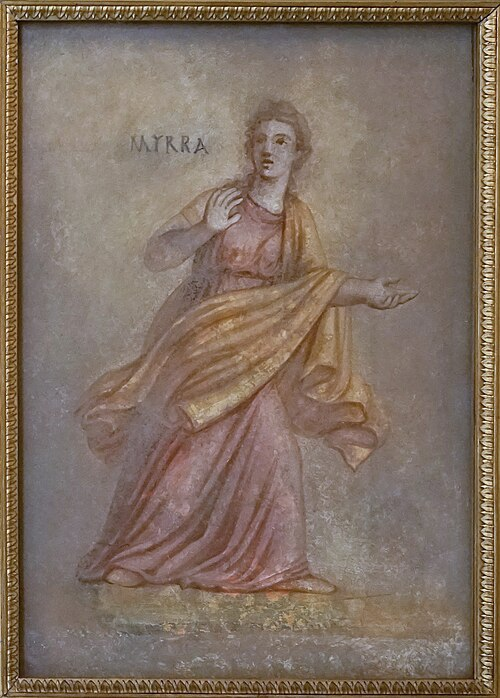
What it’s “about”: A daughter wants to shag her dad. Tries to reason from ‘nature’. Tries to top herself, is cut down by her nurse, who then colludes in the shagging of the dad. Once he turns the light on, she flees and begs to live/die, and is then turned into a tree. A child is born, to rival Cupid.
Words I didn’t know: None
Quotable quotes:
“Cinyras was Paphos’ son; if he’d been childless
Some would have called the prince a lucky man:
Even to speak of him (I’m going to sing his story)
Is warning of how everything goes wrong.
AND
Yet facts are facts, not what you wish they were.
(cf Marlo Stanfield – you want it to be one way”)
AND
The girl stared at the floor and would not speak,
Regretting that she’d been too slow at dying
And had been caught before Death captured her.
AND
The nurse, half-petrified, knew all;
Even her white hair seemed to rise in frost.
AND
Then for nine days and nights all married women
Refused to let a man take pleasure of them.
Among the stately ladies at this meeting,
Queen Cenchnes, wife of Cinyras, was the purest,
Nor failed to keep the letter of the law.
Since the king’s bed grew cold with emptiness,
And since the king drank twice his share of wine,
The old nurse said she knew a girl who loved him,
And gave a name the king had never heard ,
At this he asked how young the creature was;
Nurse said, ‘As old as Myrrha’ while the king
Told her to bring the beauty to his bed.
AND
“Filled with the fruit of love between her thighs,
She left her father’s bed and welcomed it
The following night, the next, until at last
Cinyras lit a lamp to sec his treasure.
One look at her and he went wild with horror
And raised a sword that shone beside his bed;
By Myrrha, lithe in nakedness and swift,
Slipped free and coursed her way through night beyond him,
Gliding through open fields and palm-tree shadows,
Leaving her native country far in darkness.
YIKES
AND
After nine moons of wandering foreign sands,
Heavy with child and spent, she scarcely knew
Which way to take. Her life was weariness,
Her fear was death. She prayed, ‘O gods in Heaven! —
If any god would care to hear me now —
I’ve earned my fate, but if I go on living,
My life’s a curse on all who look at me.
Or if I die, even the dead will damn me.
Nor place on Earth or in Death’s Kingdom home;
Make me a thing that neither lives nor dies.’
Some god (who’s nameless) overheard her prayer,
And as she spoke Earth seemed to rise around her;
Roots sprouted from her feet to hold her fast,
Her body upright while her bones grew strong;
Treelike, her arms became crooked heavy branches,
Rough bark encased her sides — she was all tree
That covered her thick belly, breasts, and throat.
How it lands to my eco-sensibility: xx
Obvious allusions, ways it was used (that I am aware of already) : xx
What I know I didn’t ‘get’: xx
To my knowledge, who’s used it why/how (RACC):
From wikipedia –
One interpretation of the 1700 translation of Ovid’s Myrrha-account by English poet John Dryden sees it as a metaphor for Britain’s Glorious Revolution of 1688, linking Myrrha to Queen Mary II and Cinyras to King James II.
In post-classical times, Myrrha has had widespread influence in Western culture. She was mentioned in the Divine Comedy by Dante, was an inspiration for Mirra by Vittorio Alfieri, and was alluded to in Mathilda by Mary Shelley. The play Sardanapalus by Byron included a character named Myrrha whom critics interpreted as a symbol of Byron’s dream of romantic love.
Further research questions: xx
Anything else: xx


Leave a Reply