This below is from my aged and sainted mother…
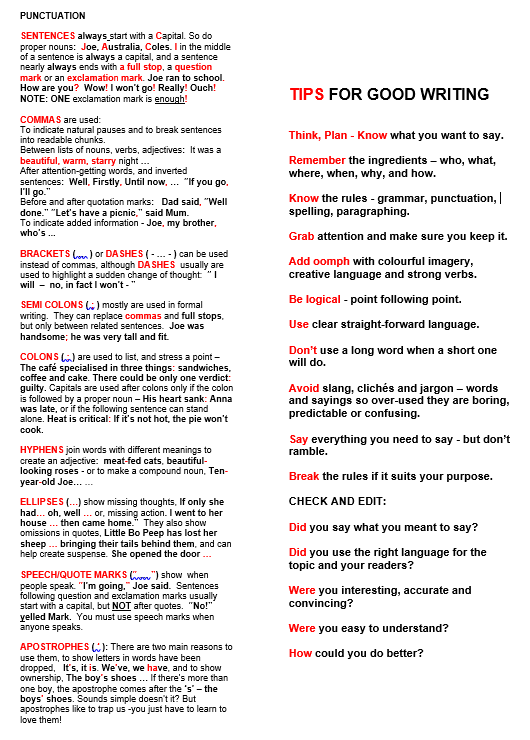
TIPS FOR GOOD WRITING
Think, Plan – Know what you want to say.
Remember the ingredients – who, what, where, when, why, and how.
Know the rules – grammar, punctuation, spelling, paragraphing.
Grab attention and make sure you keep it.
Add oomph with colourful imagery, creative language and strong verbs.
Be logical – point following point.
Use clear straight-forward language.
Don’t use a long word when a short one will do.
Avoid slang, clichés and jargon – words and sayings so over-used they are boring, predictable or confusing.
Say everything you need to say – but don’t ramble.
Break the rules if it suits your purpose.
CHECK AND EDIT:
Did you say what you meant to say?
Did you use the right language for the topic and your readers?
Were you interesting, accurate and convincing?
Were you easy to understand?
How could you do better?
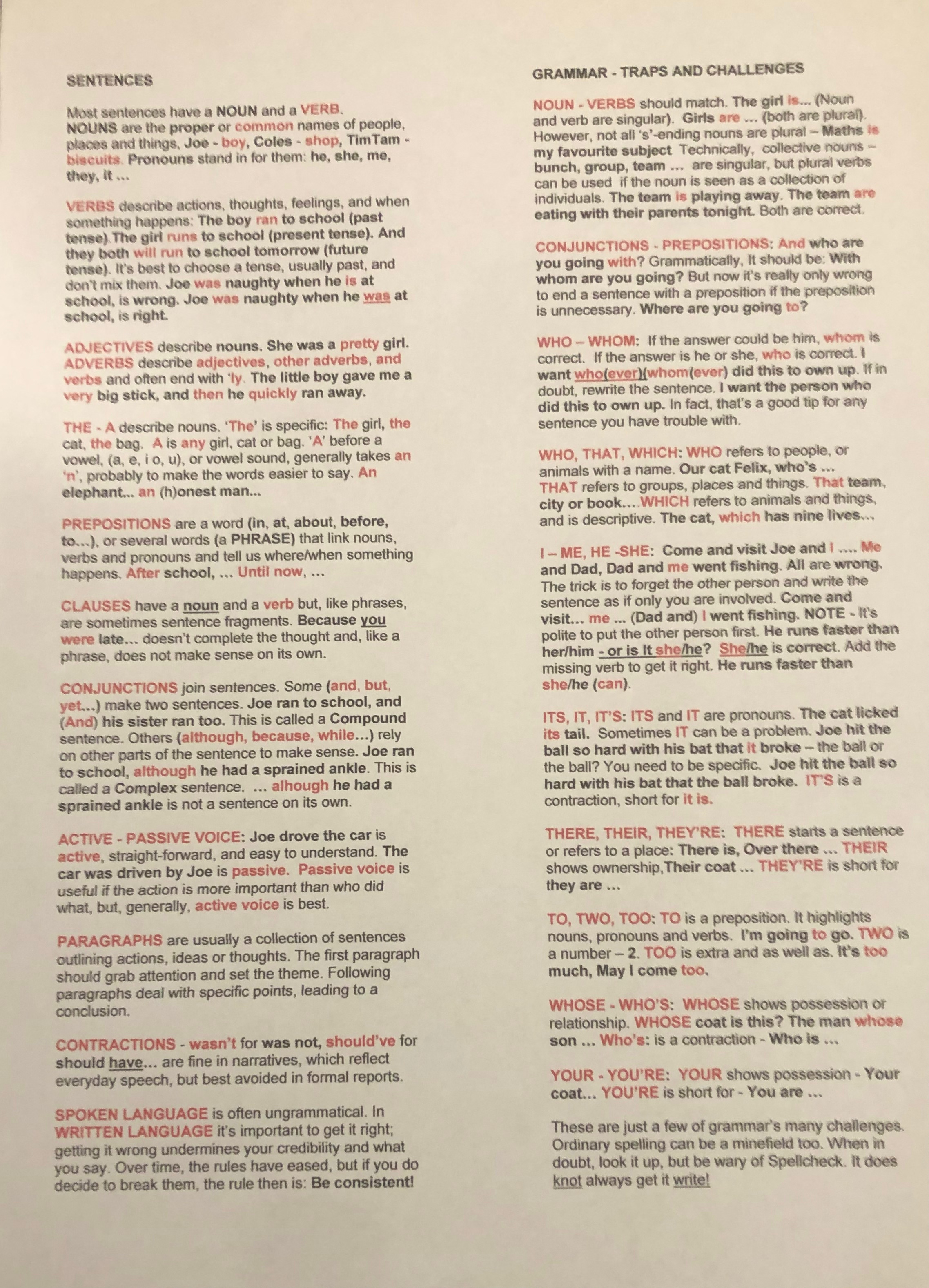
SENTENCES
Most sentences have a NOUN and a VERB.
NOUNS are the proper or common names of people, places and things, Joe – boy,Coles – shop, TimTam –biscuits. Pronouns stand in for them: he, she, me, they, it …
VERBS describe actions, thoughts, feelings, and when something happens: The boyranto school (past tense).The girl runs to school (present tense). And they bothwill run to school tomorrow (future tense). It’s best to choose a tense, usually past, and don’t mix them. Joe was naughty when he is at school, is wrong. Joe was naughty when he was at school, is right.
ADJECTIVES describe nouns. She was a pretty girl. ADVERBS describe adjectives, other adverbs, and verbs and often end with ‘ly. The little boy gave me a very big stick, and then he quickly ran away.
THE – A describe nouns. ‘The’ isspecific: The girl, the cat, the bag. A is any girl, cat or bag. ‘A’ before a vowel, (a, e, i o, u), or vowel sound, generally takes an ‘n’, probably to make the words easier to say. An elephant… an (h)onest man…
PREPOSITIONS are a word (in, at, about, before, to…),or several words (a PHRASE) that link nouns, verbs and pronouns and tell us where/when something happens. After school, … Until now, …
CLAUSES have a noun and a verb but, like phrases, are sometimes sentence fragments. Because you were late… doesn’t complete the thought and, like a phrase, does not make sense on its own.
CONJUNCTIONS join sentences. Some (and, but, yet…) make two sentences. Joe ran to school, and (And) his sister ran too. This is called a Compound sentence. Others (although, because, while…) rely on other parts of the sentence tomake sense. Joe ran to school, although he had a sprained ankle.This iscalled a Complex sentence. … alhough he had a sprained ankle is not a sentence on its own.
ACTIVE – PASSIVE VOICE: Joe drove the car isactive, straight-forward, and easy to understand. The car was driven by Joe is passive. Passive voice is useful if the action is more important than who did what, but, generally, active voice is best.
PARAGRAPHS are usually a collection of sentences outlining actions, ideas or thoughts. The first paragraph should grab attention and set the theme. Following paragraphs deal with specific points, leading to a conclusion.
CONTRACTIONS – wasn’t for was not, should’ve for should have… are fine in narratives, which reflect everyday speech, but best avoided in formal reports.
SPOKEN LANGUAGE is often ungrammatical. In WRITTEN LANGUAGE it’s important to get it right; getting it wrong undermines your credibility and what you say. Over time, the rules have eased, but if you do decide to break them, the rule then is: Be consistent!
GRAMMAR – TRAPS AND CHALLENGES
NOUN – VERBS should match. The girl is… (Noun and verb are singular). Girls are … (both are plural). However, not all ‘s’-ending nouns are plural – Maths is my favourite subject Technically, collective nouns –bunch, group, team … are singular,but plural verbs can be used if the noun is seen as a collection of individuals. The team is playing away. The team are eating with their parents tonight. Both are correct.
CONJUNCTIONS – PREPOSITIONS: And who are you going with? Grammatically, It should be: With whom are you going? But now it’s really only wrong to end a sentence with a preposition if the preposition is unnecessary. Where are you going to?
WHO – WHOM: If the answercould be him, whom is correct. If the answer is he or she, who is correct. I want who(ever)(whom(ever) did this to own up. If in doubt, rewrite the sentence. I want the person who did this to own up. In fact, that’s a good tip for any sentence you have trouble with.
WHO, THAT, WHICH: WHO refers to people, or animals with a name. Our cat Felix, who’s …
THAT refers to groups, places and things. That team, city or book….WHICH refers to animals and things, and is descriptive. The cat, which has nine lives…
I – ME, HE -SHE: Come and visit Joe and I …. Me and Dad, Dad and me went fishing. All are wrong. The trick is to forget the other person and write the sentence as if only you are involved. Come and visit… me … (Dad and) I went fishing. NOTE – It’s polite to put the other person first. He runs faster than her/him – or is It she/he? She/he is correct.Add the missing verb to get it right. He runs faster than she/he (can).
ITS, IT, IT’S: ITS and IT are pronouns. The cat licked its tail. Sometimes IT can be a problem. Joe hit the ball so hard with his bat that it broke – the ball or the ball? You need to be specific. Joe hit the ball so hard with his bat that the ball broke. IT’S is a contraction, short for it is.
THERE, THEIR, THEY’RE: THERE starts a sentence orrefers to a place: There is, Over there … THEIR shows ownership,Their coat … THEY’RE is short for they are …
TO, TWO, TOO: TO is a preposition. It highlights nouns,pronouns andverbs. I’m going to go. TWO is a number – 2. TOO isextra and as well as. It’s too much, May I come too.
WHOSE – WHO’S: WHOSE shows possession or relationship. WHOSE coat is this? The man whose son … Who’s: is a contraction – Who is …
YOUR – YOU’RE: YOUR showspossession – Your coat… YOU’RE is short for – You are …
These are just a few of grammar’s many challenges. Ordinary spelling can be a minefield too. When in doubt, look it up, but be wary of Spellcheck. It does knot always get it write!
PUNCTUATION
SENTENCES always start with a Capital. So do proper nouns: Joe, Australia, Coles. I in the middle of a sentence is always a capital, and a sentence nearly always ends with a full stop, a question mark or an exclamation mark. Joe ran to school. How are you? Wow! I won’t go! Really! Ouch! NOTE: ONE exclamation mark is enough!
COMMAS are used:
To indicate natural pauses and to break sentences into readable chunks.
Between lists of nouns, verbs, adjectives: It was a beautiful, warm, starry night …
Afterattention-getting words, and inverted sentences: Well, Firstly, Until now, … “If you go, I’ll go.”
Before and after quotation marks: Dad said, “Well done.” “Let’s have a picnic,” said Mum.
To indicate added information – Joe, my brother, who’s …
BRACKETS ( … ) or DASHES ( – … – ) can be used instead of commas,although DASHES usuallyare used to highlight a sudden change of thought: “ I will – no, in fact I won’t – ”
SEMI COLONS ( ; ) mostly are used in formal writing. They can replace commas and full stops, but only between related sentences. Joe was handsome; he was very tall and fit.
COLONS ( : ) are used to list, and stress a point –The café specialised in three things: sandwiches, coffee and cake. There could be only one verdict: guilty. Capitals are used after colons only if the colon is followedby a proper noun – His heart sank: Anna was late, or if the following sentence can stand alone. Heat is critical: If it’s not hot, the pie won’t cook.
HYPHENS join words with different meanings to create an adjective: meat-fed cats, beautiful-looking roses – or to make a compound noun, Ten-year-old Joe… …
ELLIPSES (…) show missing thoughts, If only she had… oh, well … or, missing action. I went to her house … then came home.” They also show omissions in quotes, Little Bo Peep has lost her sheep … bringing their tails behind them, and can help create suspense. She opened the door …
SPEECH/QUOTE MARKS (“ … ”) show when people speak. “I’m going,” Joe said. Sentences following question and exclamation marks usually start with a capital, but NOT after quotes. “No!” yelled Mark. You must use speech marks when anyone speaks.
APOSTROPHES ( ‘ ): There are two main reasons to use them, to show letters in words have been dropped, It’s, it is. We’ve, we have,and to show ownership, The boy’s shoes … If there’s more than one boy, the apostrophe comes after the ‘s’ – the boys’ shoes. Sounds simple doesn’t it? But apostrophes like to trap us -you just have to learn to love them!

