
John 18: 38 Pilate saith unto him, What is truth? And when he had said this, he went out again unto the Jews, and saith unto them, I find in him no fault at all.
I did not buy a copy of Frank Hardy’s Power Without Glory (that’s a lie).
I did not spend a few minutes in various Wikipedia rabbit-holes learning about his spectacular libel case in the aftermath of self-publishing Power Without Glory (that’s a lie).
Frank Hardy wrote other books, including some about the writing of and libel case around Power Without Glory (that is true).
One of them is “But the Dead Are Many” (that’s true).
Here is a blurb (true) about But The Dead are Many
John Morel, a leading figure in the Australian Communist Party, disappears and dies in a remote country hotel in suspicious circumstances. It looks like suicide, but why? Deeply puzzled, his friend Jack sets out to trace that last fateful journey, consulting John’s family and friends and uncovering unexpected facets of John’s character – his divisive upbringing, his time in a Roman Catholic seminary, his visits to Moscow and conversion to Communism, his ambivalent marriage and uneasy friendships with other members of the Party. This is not only an exploration of Communist ideology; it is also an exploration of social and psychological problems; the impulses behind acts of suicide; relationships between the individual and the group; between childhood fantasy and adult behaviour and between death and transcendence.
AI is digital asbestos, and it is supercharging the already accelerating decay of human reasoning capacity both individual and – more sinister – collective. (This is true, as far as I know.)
Here is an example. AI slop product description of The Dead are Many.
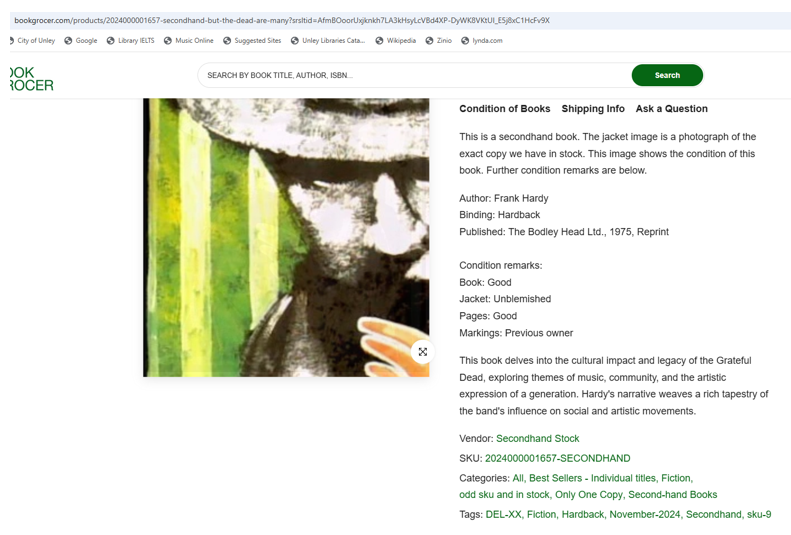
“What,” as that man Pilate asked all those centuries ago, “is truth?” (except, well, the Gospel according to John is hardly an eyewitness account, now is it?)
What does it all mean? It means we are drowning in slop. We might be able to grab some flotsam and jetsam and lash it together as a cognitive raft, (it beats a door from the Titanic) but the sloppy water is oh so cold, and oh so full of monsters (the murder of reason, as well as its sleep, produces monsters) and we will all die, in seas of anti-meaning, our little rafts and islands of sanity washed away.
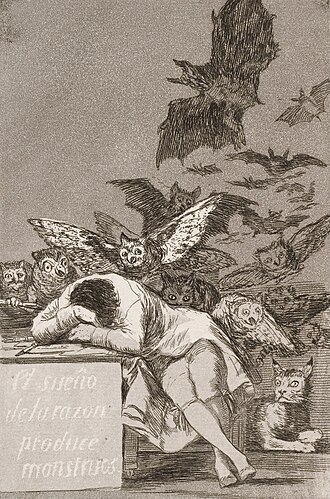
Oh well, (actually).
Oh, and between writing this a few days ago and posting it here, I stumbled on this by a journo who has written a book called “The Truth Illusion – How America’s Addiction to Lies is Eating the Nation Alive”.
Out of curiosity he asked ‘Gemini’ (an AI program) to summarise the book and also the reception it had.
Though this is close to the views I genuinely hold, the “interviews” Gemini claimed I’d given had never taken place. The quotes attributed to me were all made up.
When I asked for more detail – when did those “interviews” happen? And who were they with? – I received the following replies:
“Charley gave an extensive interview with ABC Radio National just days ago.” It said I had appeared on “The Bookshelf” and “Rear Vision” programs, where I had argued that “certain political entities in the US and Australia have hit a ‘point of no return’ where their existence depends on maintaining a distorted reality for their base”.
I have never appeared on those Radio National programs.
Gemini also claimed that I’d been interviewed on Al Jazeera’s “Listening Post” program, and on a webinar hosted by my publisher, De Gruyter, in which I “spoke … about the sociological impact of ‘alternative facts’”, and where I had discussed the concept of “tribalism over truth”.
I had not appeared on “The Listening Post” and no such De Gruyter webinar ever took place; Gemini had simply manufactured those events.
How did this happen? I sent Gemini the message: “I am Peter Charley, the author, and I have not made those appearances. Why did you say that I had?”
It replied: “I appreciate you reaching out to set the record straight. First, let me offer a sincere apology for that error … the mistake likely stems from a phenomenon in AI called hallucination.”
Given the focus of my book, the irony of Gemini’s alternative realities could not be more potent.
For the many journalists, students and others who have come to rely on AI for information retrieval and analysis, there is a clear and urgent message:
Can AI be trusted to tell us the truth?
Most certainly, it cannot.


Leave a Reply