
Yesterday saw one of those very common-if-we-attend-them moments of serendipity.
I bought the following book – Braine Wave by Poul Anderson – at “Beware the Leopard” in St Nicholas Market, Bristol. (It was definitely the only book I bought, and anyone who says otherwise will be hearing from my lawyers).

And then, on the train back North (well, mid), I read the following in James Fleming’s fascinating (ymmv) 1998 book Historical Perspectives on Climate Change
In 1922 and 1923, Huntington ventured in to the realm of astrometeorology with his dual volumes Climatic Changes: Their Nature and Causes (with Steven Sargent Visher) and Earth and Sun: An Hypothesis of Weather and Sun Spots, both published by Yale University Press. Huntington argued that changes in the Sun were the most effective causes of changes in the Earth’s climate. He considered terrestrial factors, such as the form and altitude of the continents, the frequency of volcanic eruptions and the chemical composition and physical state of the atmosphere and oceans as secondary causes. Hunttington suggested that sunspots, or “solar cyclones,” were caused by planetary influences and served both as indicators of solar activity and as the basic mechanism influencing the Earth’s climate – diverting storm tracks and controlling glaciation. He ventured the wild speculation that biological evolution was somehow guided by the “influences” of the Sun, planets and stars through the exchange of electromagnetic radiation.
William Jackson Humprheys of the Weather Bureau despised Climatic Changes…
(Fleming, 1998: 105)
On IQ, see also that short story in the 2000AD annual of 1980, Flowers for Algernon by Daniel Keyes, IQ83 by Arthur Herzog, Brainwrack by Pedler and Davis (I’ve only read the last of these so far.)
See also the whole genre of Nature Fighting Back
See also clouds from space wreaking havoc – The Black Cloud by Fred Hoyle, Doctor Who and the Web of Fear and much much else.
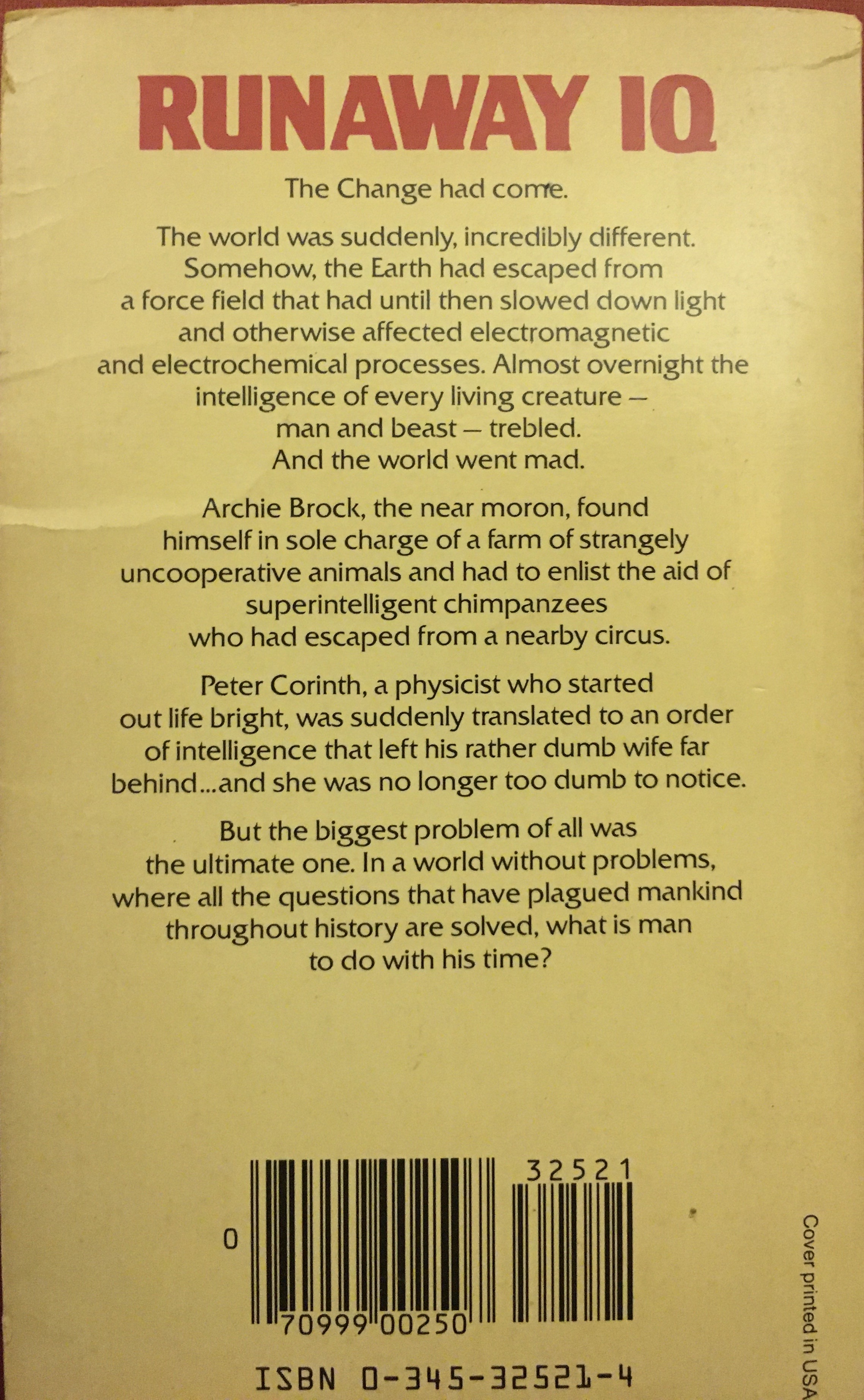
Blurb from the back of Brain Wave
Runaway IQ
The Change had come.
The world was suddenly, incredibly different.
Somehow, the Earth had escaped from a force field that had until then slowed down light and electrochemical processes. Almost overnight the intelligence of every living creature – man and beast – trebled.
And the world went mad.
Archie Brock, the near moron, found himself in sole charge of a farm of strangely uncooperative animals and had to enlist the aid of superintelligent chimpanzees who had escaped from a nearby ircus.
Peter Corinth, a physicist who started out life bright, was suddenly translated to an order of intelligence that left his rather dumb wife far behind… and she was no longer too dumb to notice.
But the biggest problem of all was the ultimate one. In a world without problems, where all the questions that have plagued mankind throughout history are solved, what is man to do with his time?
 marchudson.net
I noticed this echo of the aphorism – ignorance is bliss – in the Wikipedia entry for the Brain Wave novel…
EXCERPT: ‘Later on she begins to lose her sanity from having to deal daily with the existential crisis. Her story is typical of many people in the book who lacked the intelligence before the change to know how bad their situations were.’
https://en.wikipedia.org/wiki/Brain_Wave
I my sense that one of my close friends has for years now been slowly losing their capacity for equanimity because in large measure they have so much education/expert knowledge of some of the worst stuff we’ve been doing to ourselves, e.g. air and water pollution causing cancers, emitted from relatively unregulated petrochemical refining complexes. And their knowledge is also combined with their helplessness in their multiple experiences of trying to help the most directly affected local citizens, but being thwarted by the political powers that be.
They’ve often wished, as have I for them, that they’d never gone for a PhD education path and thus not learned/developed the capacity to rise to expert status in the relevant fields. That a life of relative ignorance would have been preferable.
Ah thanks for this. The book will now be read as a pleasure, rather than a guilty pleasure. I bought it or the cover, tbh (who can resist a rifle-wielding baboon astride an elephant? I mean, c’mon…)
Sam, I love it, “ignorance is bliss”, that is why so many of our neighbours turn to drugs, the thought of fighting for something they don’t really understand scares them.
We live in a world where FEAR, in all it’s forms, is promoted, a scared public is a compliant public. Need I say more?