
In 2026 I plan to read all the Conan Doyle “Sherlock Holmes” works – 56 short stories and 4 novels (here’s why and how). If you haven’t already read it, Michael Green’s “undiscovered letter” from John Watson is fricking hilarious.
[In February my target is to read all (or at very least most) of the 12 stories in Memoirs of Sherlock Holmes and also the 13 in The Return of Sherlock Holmes.]
I may also read various Holmes homages/pastiches etc. Who knows? (btw I’d recommend the Seven Per Cent Solution, by Nicholas Meyer where Watson has to trick Holmes into going to Vienna to be treated by Sigmund Freud).
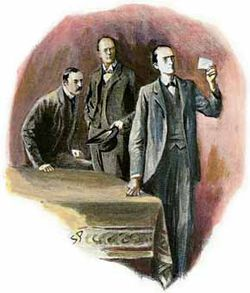
Published: December 1903
Wikipedia here
Online here
Review: I would recommend this – it’s fun. Yet another Woman’s past catching up with her one (Yellow Face, Charles Augustus Milverton etc etc)
But Holmes really dropped a bollock here.
Obviously, Holmes could not have known that the tragedy would occur that very night. But this isn’t a simple matter of hindsight. Sherlock, again by his own admission, realized that “the rascal was proceeding from persuasion to threats,” and that “he might very rapidly put his words into action.” Certainly that justified swift action, as did Holmes declaration that Cubitt was trapped in a “singular and dangerous web.” When Holmes says that it is “even more essential that we should not lose an hour in letting Hilton Cubitt know how matters stand,” there simply no excuse for waiting until the next morning.
What options did the detective have? Some have suggested that he and Watson take one of the mail trains, which ran later. Perhaps he could have hired a “special,” a direct express, as Moriarty did in The Final Problem. I’m not familiar enough with British railway policy of the time to know how feasible either of these plans could be.
But in the name of all that is holy, WHY DIDN’T HOLMES SEND A TELEGRAM?!?!? [Sorry, but that really needed emphasis.] Throughout the Canon, Sherlock would send a wire at the drop of a hat. But here, in a situation where “they should not lose an hour in letting Cubitt know,” Holmes doesn’t appear to even consider the possibility of sending the squire a telegram of warning. Holmes could also have telegraphed the Norfolk police–surely a cable from Sherlock Holmes would have roused attention, and gotten at least a cursory police presence at the house to deter Slaney. Or a message to Lestrade or other Scotland Yard official that a dangerous American villain was lurking in the area would likely have produced some response.
For that matter, what about telephones? Holmes never seemed fond of the device, but they certainly existed in 1898. And even if the Cubitt’s didn’t have a phone on their property, someone in Norfolk must have–the police, the city council, someone.
An Observance Of Trifles: The Adventure Of The Dancing Men–Who Is To Blame?
Best sentence(s):
Holmes had been seated for some hours in silence with his long, thin back curved over a chemical vessel in which he was brewing a particularly malodorous product.
Xxxxxx
“You see, my dear Watson”—he propped his test-tube in the rack and began to lecture with the air of a professor addressing his class—“it is not really difficult to construct a series of inferences, each dependent upon its predecessor and each simple in itself. If, after doing so, one simply knocks out all the central inferences and presents one’s audience with the starting-point and the conclusion, one may produce a startling, though possibly a meretricious, effect
Xxxxxx
far from the fogs of Baker Street
Xxxxxxx
. I can’t say that she did not give me every chance of getting out of it if I wished to do so. ‘
Xxxxxx
He was a fine creature, this man of the old English soil, simple, straight, and gentle, with his great, earnest blue eyes and broad, comely face. His love for his wife and his trust in her shone in his features
Xxxxxxx
“I think, gentlemen,” said Holmes, quietly, “that we had best take up our position behind the door. Every precaution is necessary when dealing with such a fellow. You will need your handcuffs, inspector. You can leave the talking to me.”
Xxxxxx
“What one man can invent another can discover,” said Holmes
Xxxxxxx
“It is my duty to warn you that it will be used against you,” cried the inspector, with the magnificent fair-play of the British criminal law
Xxxxxx
 marchudson.net
Leave a comment