
In 2026 I plan to read all the Conan Doyle “Sherlock Holmes” works – 56 short stories and 4 novels (here’s why and how). If you haven’t already read it, Michael Green’s “undiscovered letter” from John Watson is fricking hilarious. I may also read various Holmes homages/pastiches etc. Who knows? (btw I’d recommend theSeven Per Cent Solution, by Nicholas Meyer where Watson has to trick Holmes into going to Vienna to be treated by Sigmund Freud).
In February my target is to read all (or at very least most) of the 12 stories in Memoirs of Sherlock Holmes
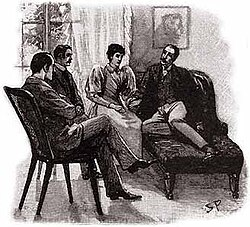
Published: Oct/Nov 1893
Wikipedia here
Online here
Review: I would recommend this, but it hinges on some quite extraordinary coincidences and an inexplicably blind policeman
Well, this from Wikipedia was interesting
“In 1889, four years before the story was published, Britain enacted its first Official Secrets legislation.[5] This was prompted by the case of Charles Thomas Marvin, a copying clerk at the Foreign Office who had in reality a position very similar to that of Phelps in the story; he was employed to make a copy of a secret treaty with Russia, and promptly disclosed its contents to the press. Marvin was arrested, but was released after it was found that he had committed no offence known to English law; the Official Secrets legislation was aimed at creating such an offence for future cases. The Marvin case got considerable public attention, and Conan Doyle likely knew of it.”
The details are in the wikipedia entry for Marvin
On 16 July 1877 he entered the Foreign Office as a copying clerk. On 29 May 1878 he was employed to make a copy of a secret treaty with Russia, the “Anglo Russian Convention of 30th May 1878”. The same evening he supplied The Globe and Traveller with a summary of the treaty from memory. On 1 June Lord Salisbury, the then Foreign Secretary, faced with the alternative of admitting the secret deal,[1] said in the House of Lords that this summary was “wholly unworthy of their lordships’ confidence”. On 14 June The Globe printed a complete text of the treaty which Marvin had again provided from memory.
On 26 June Marvin was arrested, but was released on 16 July after it was found that he had committed no offence known to English law. His actions prompted a tightening of internal regulations that eventually led to the enactment in 1889 of Britain’s first Official Secrets legislation.[2]
There has also been some undercover work by a “Woman Police Officer” – getting the suspect woman drunk and pumping her for info.
Best sentence(s):
“A very commonplace little murder,” said he. “You’ve got something better, I fancy. You are the stormy petrel of crime, Watson. What is it?” I handed him the letter, which he read with the most concentrated attention
******
“I won’t waste your time,” said he, raising himself upon the sofa. “I’ll plunge into the matter without further preamble
*****
EAOY – “£10 reward. The number of the cab which dropped a fare at or about the door of the Foreign Office in Charles Street at quarter to ten in the evening of May 23d [1889]. Apply 221b, Baker Street.”
*****
“Then for the first time the horror of my situation came in its full force. Hitherto I had been acting, and action had numbed thought.
******
“…. I turn to you, Mr. Holmes, as absolutely my last hope. If you fail me, then my honor as well as my position are forever forfeited.”
*****
I have no doubt I can get details from Forbes. The authorities are excellent at amassing facts, though they do not always use them to advantage.
*****
“Do you see any clue?”
“You have furnished me with seven, but, of course, I must test them before I can pronounce upon their value.”
*****
” He sank back into the state of intense and silent thought from which he had emerged; but it seemed to me, accustomed as I was to his every mood, that some new possibility had dawned suddenly upon him.
*****
He had, when he so willed it, the utter immobility of countenance of a red Indian, and I could not gather from his appearance whether he was satisfied or not with the position of the case.
*****
“Do you know,” said he, “that I begin to believe that I am the unconscious centre of some monstrous conspiracy, and that my life is aimed at as well as my honor?”
*****
“Upon my word, you may put it down to my weak nerves or not, but I believe there is some deep political intrigue going on around me, and that for some reason that passes my understanding my life is aimed at by the conspirators. It sounds high-flown and absurd, but consider the facts! Why should a thief try to break in at a bedroom window, where there could be no hope of any plunder, and why should he come with a long knife in his hand?”
*****
To my certain knowledge he [Holmes] has acted on behalf of three of the reigning houses of Europe in very vital matters.”
*****
“On the contrary, I have noticed that when he is off the trail he generally says so. It is when he is on a scent and is not quite absolutely sure yet that it is the right one that he is most taciturn.
*****
“The principal difficulty in your case,” remarked Holmes, in his didactic fashion, “lay in the fact of there being too much evidence. What was vital was overlaid and hidden by what was irrelevant. Of all the facts which were presented to us we had to pick just those which we deemed to be essential, and then piece them together in their order, so as to reconstruct this very remarkable chain of events.
*****
“It may be so,” answered Holmes, shrugging his shoulders. “I can only say for certain that Mr. Joseph Harrison is a gentleman to whose mercy I should be extremely unwilling to trust.”
Words I didn’t know:
| chevy | |
| List slippers | More particularly, a list was the border or edging of a piece of cloth, its selvage, woven in a slightly different way from the body of the material so that it would not fray or unravel. List slippers were made of material woven in this way.List slippers were often worn when quiet was needed, say when somebody in the house was ill and people walking about in ordinary shoes on bare floors would disturb themList slippers |
| “His conversation, I remember, was about the Bertillon system of measurements, and he expressed his enthusiastic admiration of the French savant.” | The Bertillon System, developed by French anthropologist Alphonse Bertillon in 1879, was a technique for describing individuals using photographs and measurements of specific physical characteristics. The system was used to track and identify suspects and criminals. |
 marchudson.net
Leave a comment