
Fifteen years ago I read the Old Testament (King James Version) and blogged it as I went. I always meant to keep on trucking, but, well, I didn’t.
Now, in January and February of 2026 I am going to read all 27 books of the New Testament (I have a passing familiarity with the Gospels, thanks to secondary school, and I did read the Book of Revelations at some point (fever dream, innit?)
The plan is to read at most ten pages a day, with rest days more frequent than old “1-in-7” for the Gospels through Romans, but then, because it all gets somewhat shorter, one a day for most of February.
Crucially, am blogging as I go.
Oh, and I am going to read Gore Vidal’s 1992 “Live from Golgotha” as soon as I am done with John…
Summary:
Born in a manger, starts with the miracles…Almost gets thrown off a cliff (4: 28-30). More miracles.
Historical – when written, by whom
According to Wikipedia
The Gospel of Luke[a] is the third of the New Testament‘s canonical Gospels. It tells of the origins, birth, ministry, death, resurrection, and ascension of Jesus.[5] Together with the Acts of the Apostles, it makes up a two-volume work called Luke–Acts,[6] accounting for 27.5% of the New Testament.[7]
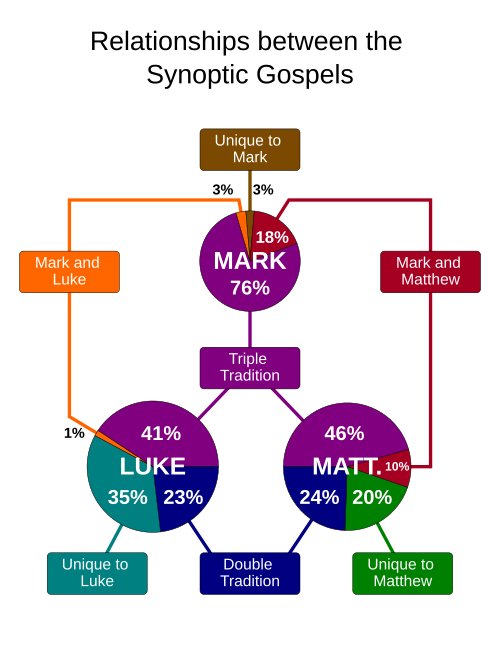
The text is anonymous, not naming its author.[8][9] Perhaps most scholars think that he was a companion of Paul, but others cite differences with the Pauline epistles.[10][11][12] In the popular Two-source hypothesis, Luke used the Gospel of Mark and a hypothetical Q source, though alternative hypotheses positing a direct relation between Matthew and Luke without Q are increasing in prominence.[13][14][15] Luke follows Mark closely compared to other ancient historians’ usage of sources, though the parallels and variations of the Synoptic gospels are typical of ancient historical biographies.[16][17] Luke tends to follow his sources closely when checked.[18] The most common dating for its composition is around AD 80–90. The earliest witnesses for Luke are the Alexandrian and the revised western text-type.[19][20][21]
Most poetic bits
Poetic – terraforming (John the baptist)
3: 5 Every valley shall be filled,
And every mountain and hill shall be brought low;
And the crooked shall be made straight,
And the rough ways shall be made smooth;
Most quotable bits
oh, so so many. This is the best Gospel so far for this stuff, imo.
Most “wtaf” bit(s)
xxx
What it reminds me of (books/plays/jokes etc)
Well, the Dead Parrot sketch, obviously (last verses of Chapter 8)
Further reading
Xx
Chapter 1
No false modesty HERE , then.
1: 3 3it seemed good to me also, having had perfect understanding of all things from the very first, to write unto thee in order, most excellent Theophilus,
It’s weird being the same age as old people…
1: 7And they had no child, because that Elisabeth was barren, and they both were now well stricken in years.
John the Baptist
Gabriel mutes him.
Gabriel then visits Mary, Liz’s cousin
How about a right-angled equilateral triangle? Or a boulder so heavy She can’t lift it.
1: 37 For with God nothing shall be impossible.
1: 51 He hath shewed strength with his arm;
He hath scattered the proud in the imagination of their hearts.
1: 52 He hath put down the mighty from their seats,
And exalted them of low degree.
Chapter 2
Taxing times.
And then
2: 40 And the child grew, and waxed strong in spirit, filled with wisdom: and the grace of God was upon him.
Jesus at age twelve left behind at the temple
Chapter 3
Poetic – terraforming (John the baptist)
3: 5 Every valley shall be filled,
And every mountain and hill shall be brought low;
And the crooked shall be made straight,
And the rough ways shall be made smooth;
3: 7 Then said he to the multitude that came forth to be baptized of him, O generation of vipers, who hath warned you to flee from the wrath to come?
Problematic anthropocentric deforestation
3: 9 And now also the axe is laid unto the root of the trees: every tree therefore which bringeth not forth good fruit is hewn down, and cast into the fire.
Redistribution by commie jesus
3: What shall we do then? 11He answereth and saith unto them, He that hath two coats, let him impart to him that hath none; and he that hath meat, let him do likewise. you.
Latchet a narrow thong or lace for fastening a shoe or sandal.
3: 24-38 – genealogy
Chapter 4
40 days of hunger then temptations
4: 23 23And he said unto them, Ye will surely say unto me this proverb, Physician, heal thyself: whatsoever we have heard done in Capernaum, do also here in thy country.
4: 24 And he said, Verily I say unto you, No prophet is accepted in his own country
4: 28-30 28And all they in the synagogue, when they heard these things, were filled with wrath, 29And rose up, and thrust him out of the city, and led him unto the brow of the hill whereon their city was built, that they might cast him down headlong.
Jesus starts miracling.
Chapter 5
Jesus offers (good) fishing advice
5: 4-6 4Now when he had left speaking, he said unto Simon, Launch out into the deep, and let down your nets for a draught. 5And Simon answering said unto him, Master, we have toiled all the night, and have taken nothing: nevertheless at thy word I will let down the net. 6And when they had this done, they inclosed a great multitude of fishes: and their net brake.
More miracles, hanging out with bad people
5: 37-8 37And no man putteth new wine into old bottles; else the new wine will burst the bottles, and be spilled, and the bottles shall perish. 38But new wine must be put into new bottles; and both are preserved.
5: 39 39No man also having drunk old wine straightway desireth new: for he saith, The old is better.
Chapter 6
Shewbread? twelve loaves placed every Sabbath in the Jewish Temple and eaten by the priests at the end of the week.
The hand physio in public again…
We meet the Apostles
6: 3-16
More class war!
6: 24 But woe unto you that are rich! for ye have received your consolation.
Turn the other cheek
6: 29 And unto him that smiteth thee on the one cheek offer also the other; and him that taketh away thy cloke forbid not to take thy coat also.
6: 37 judge not, and ye shall not be judged: condemn not, and ye shall not be condemned: forgive, and ye shall be forgiven:
6: 39 And he spake a parable unto them, Can the blind lead the blind? shall they not both fall into the ditch?
6: 41 And why beholdest thou the mote that is in thy brother’s eye, but perceivest not the beam that is in thine own eye?
POETIC
6: 44 For every tree is known by his own fruit. For of thorns men do not gather figs, nor of a bramble bush gather they grapes.
6: 48-9 he is like a man which built an house, and digged deep, and laid the foundation on a rock: and when the flood arose, the stream beat vehemently upon that house, and could not shake it: for it was founded upon a rock. 49But he that heareth, and doeth not, is like a man that without a foundation built an house upon the earth; against which the stream did beat vehemently, and immediately it fell; and the ruin of that house was great.
Chapter 7
More miracles
Helps out a centurion with sick famil
7: 14-15 Raises the dead
14 And he came and touched the bier: and they that bare him stood still. And he said, Young man, I say unto thee, Arise. 15And he that was dead sat up, and began to speak. And he delivered him to his mother.
Feasts with Pharisee
Sinner woman (sex worker?)( washes his feet etc, is forgiven)
Chapter 8
Travels with men
And women
8: 2-3 2and certain women, which had been healed of evil spirits and infirmities, Mary called Magdalene, out of whom went seven devils, 3and Joanna the wife of Chuza Herod’s steward, and Susanna, and many others, which ministered unto him of their substance.
Parable f sower – compare with info deficit – there has to be the right conditions (verse 15)
5A sower went out to sow his seed: and as he sowed, some fell by the way side; and it was trodden down, and the fowls of the air devoured it. 6And some fell upon a rock; and as soon as it was sprung up, it withered away, because it lacked moisture. 7And some fell among thorns; and the thorns sprang up with it, and choked it. 8And other fell on good ground, and sprang up, and bare fruit an hundredfold. And when he had said these things, he cried, He that hath ears to hear, let him hear
8: 15But that on the good ground are they, which in an honest and good heart, having heard the word, keep it, and bring forth fruit with patience.
Truth will out
8: 17 17For nothing is secret, that shall not be made manifest; neither any thing hid, that shall not be known and come abroad.
Redistribution the wrong way – The Matthew Effect
8: 18 – 18Take heed therefore how ye hear: for whosoever hath, to him shall be given; and whosoever hath not, from him shall be taken even that which he seemeth to have.
Bloody paparazzi, even in ye ancient times…
8: 19 Then came to him his mother and his brethren, and could not come at him for the press.
That boat trip and the calmed waters…
Exorcism of the Gerasene demoniac – Wikipedia
8: 29-33 29(For he had commanded the unclean spirit to come out of the man. For oftentimes it had caught him: and he was kept bound with chains and in fetters; and he brake the bands, and was driven of the devil into the wilderness.) 30And Jesus asked him, saying, What is thy name? And he said, Legion: because many devils were entered into him. 31And they besought him that he would not command them to go out into the deep. 32And there was there an herd of many swine feeding on the mountain: and they besought him that he would suffer them to enter into them. And he suffered them. 33Then went the devils out of the man, and entered into the swine: and the herd ran violently down a steep place into the lake, and were choked.
“The story was interpreted by Saints Augustine of Hippo and Thomas Aquinas to mean that Christians have no duties to animals.[4] It has been a point of contention in discussions of Christianity and animal rights”
Assholes.
Also, “This episode plays a key role in the literary critic René Girard‘s theory of the Scapegoat.[21] In his analysis, the opposition of the entire city to the one man possessed by demons is the typical template for a scapegoat. Girard notes that, in the demoniac’s self-mutilation, he seems to imitate the stoning that the local villagers would likely have attempted to use against him to cast him out of their society, while the villagers themselves show by their reaction to Jesus that they are not primarily concerned with the good of the man possessed by demons:”
Poetic
8: 37 Then the whole multitude of the country of the Gadarenes round about besought him to depart from them; for they were taken with great fear; and he went up into the ship, and returned back again.
Raises the dead(again) “Not dead, but sleepeth”8: 52-3 52And all wept, and bewailed her: but he said, Weep not; she is not dead, but sleepeth. 53And they laughed him to scorn, knowing that she was dead.
Cf the Dead Parrot, obvs, in Monty Python.
 marchudson.net
Leave a comment