
There are good films, beautifully made, which you probably will only watch the once. That’s a niche category and for me there was only one – Paul Greengrass’s 911 quasi-documentary United 93. Now there are two – The Long Walk, based on a 1979 Stephen King book.
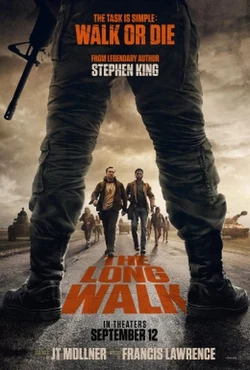
There is an obvious, perhaps even glib, way of situating this film, which has a simple premise; 50 young men have won a ‘lottery‘ (think Shirley Jackson) and assemble on the appointed morning. The film starts with Ray Garraty (brilliantly played by Cooper Hoffman, son of the late great Philip Seymour Hoffman) being driven by his desperate mother (an excellent Judy Greer). Because if feels like you win when you lose: the young men will begin to walk, at 3 miles an hour. No sleep, no stops, no excuses. After a certain number of warnings for failing to move at the requisite pace, well, “your ticket is punched” by the flanking soldiers. There can be, as per Highlander, only one. And they will get a million dollars and a wish…
So – a simple parable for neoliberal capitalism. The book came out in 1979, the banner year for all that (as described here). There’s the violence of the state, the exhortations for “hope” (one of the best lines, delivered by an impressive Mark Hamill as the baddie “Major”). There’s the gruelling cruelty, the impossibility of collective action to change the rules of the game. You can point to the about to be released reboot of “The Running Man,” another Stephen King book with a similar premise. You can talk about the failure of the Long March (Mao) and there being no institutions to do a Long March through (Rudi Dutschke) anyway.
But this founders on the fact that “human beings being hunted for sport/political reasons” is hardly a new idea. I am sure “The Most Dangerous Game” (the 1924 short story and then film in 1932). There was 1975’s Rollerball, in 1982 Turkey Shoot (Australian video-nasty) and Battle Royale, Series 7: The Contenders, The Hunt etc.
Still and all, “Neoliberalism is Bad and here is a parable about that” is an entirely valid way of thinking about this film, but I think it misses the main game. And the main game is… sorry, wifey… Sigmund Freud.
This is a film about fathers and sons in the same way Contagion is about fathers and daughters.
The three central walkers (Ray, Pete, Stebbins) all have explicit “issues” around their fathers (absent or present, for one reason or another). Nurturing fathers, violent fathers, abusing etc etc. Trying to heal wounds, redeem selves or memories, re-find lost love. It’s all very rich pickings for the Fraudians.
This is also film about Men Without Women, (think Full Metal Jacket, The Lord of the Flies) and various (unspoken, but heavily lamp-shaded) forms of homosexual love and attempts to build families without mothers.
The casting is uniformly excellent, but perhaps the cleverest, given the above, is that of Mark Hamill as “the Major” given that his most famous role is that of a young man who learns that his dad went over to the Dark Side.
But beyond this, this is a film about the id, death, love and… shitting.
We are all mostly inured to graphic images of violent death (1). And The Long Walk does not shy away – there are several “bullet passing through a skull” representations (not in slo-mo, which makes The Long Walk’s portrayal all the more effective). As per that famous Eddie Adams image during the Tet Offensive.) But I cannot recall ever having seen defecation – and the inverse of “you can even seeing it going in” to “you can even see it coming out” – so graphically represented in a film. And the link with death is, well, quite starkly made.
So, a decent essay, better than I have time (brainpower too, I fear) for would look at this through a post-Freudian lens, picking apart the myths of neoliberalism but using feminism, ecological thinking (there’s lots of stuff about animals) and so on. The only thinker that comes to mind at the moment is Wilhelm Reich, but that’s a looooooooong time ago (1930s) and if you know some psychoanalytic thinking that doesn’t shy away from capitalism, have at me. Judith Butler? Don’t say Zizek: please don’t say Zizek.
I am making the film sound heavy, and it IS, but not in the ways you’d think. This is brilliantly made (one very minor quibble about what I think is a failure of nerve in the cinematography at the very end, akin to the last Lord of the Rings Film). The astonishing and Oscar-worthy key performance is that of the (British) actor David Jonsson playing Ray’s saviour Pete. It’s a difficult role, and he smashes it out of the park.
So, this is a great film. But you will probably only watch it the once.
Coda (What I would do had I the ‘following’ and money)
Show this as a double bill followed by discussion with… Top Gun: Maverick – another film about nostalgia for a simpler/better past, of absent fathers and past sins (albeit with a somewhat, ah, “less problematising” use of military memes.
Footnotes
(1) I remember the late great English author Julian Rathbone explaining how the Germans had this inverted. When a German co-production TV show was being made of his thriller “Dangerous Games” there was a level of explicitness about sex that would never have got past English rules. But representations of physical violence almost had to be alluded to rather than shown. This was well over thirty years ago, and maybe things have changed?
 marchudson.net
I had to stop reading – this seems really interesting and I didnt want spoilers. Thanks for sharing.
I thiiiiink it’s a spoiler-free zone. But do go see the film (you will need a stiff drink afterwards) and then let me know what you think…