
A Looting the Ivory Tower on
Sovacool, B. 2024. The promise and peril of sociotechnical visions of the future. Nature Reviews Physics. https://doi.org/10.1038/s42254-024-00774-5
Not all academic work is self-serving word-spinning helpfully quarantined behind paywalls and verbiage walls. I wouldn’t want to hazard a percentage, and it varies from a) field to field and b) taste to taste.
Until I had an incident involving a really pathetic nasty florid narcissist last year, I was doing semi-regular “Looting the Ivory Tower” 2 minute videos, where I explained a recent paper. I may ease back into that, via some short blogs about papers I read.
Before I launch into this one – a disclaimer. The author of this two-pager, Benjamin Sovacool is a former boss of mine who has over the years been supportive and practically helpful (and not just to me – lots of folks). I’d therefore be unlikely to rip into it (for the most part, I don’t waste too much of mine or other people’s time and attention going on about crap, unless there’s a wider point to be made). So, “MRDA.”
What it is
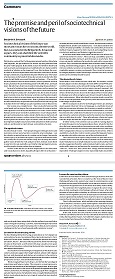
This is a two page comment piece within the field of “sociotechnical transitions”. What they? Well, we are surrounded by sociotechnical systems, and they are stable for a long time (they wouldn’t really count as systems if they weren’t!) until “suddenly” (years, decades) they change. Time is short, so I am simply going to cut and paste from something I wrote ten years ago when I was starting out on a PhD (which underwent a radical, ah, “transition;, but that’s another story).
What’s my PhD about? How long have you got? The short, medium or long version?
You want the long version? Wow, that’s masochism. Okay, just feign death when you’ve had enough, or kick me.I’m looking at sustainability socio-technical transitions.
Yeah, I know! Let me unpack that all for you.
Let’s start with sailing ships. If you looked at how a sailing ship was made, say 200 yeas ago, it wasn’t significantly different from 400 years before that. Sure, there were innovations and changes, but someone from 1400 would recognise what was going on. You’ve got the forests where people look after the trees, picking which ones are going to be masts, and the hull and so on. You have the people who chop them down, the people who transport them. You have the workers at the ship-building yard who build it. You have the sail-makers, the rope makers. The sailors, the people who train them, the navigators. The insurers. The people who supply the food, the barrels.
What’s that? You get the point but you don’t know what the point is?
Well, a sailing ship is a technology, yes. But it’s embedded in a a social system, in which different groups are getting their financial, cultural and social needs met. There are hierarchies, knowledge and all that. So the sailing ship is part of a “socio-technical system.”
Now, along come steamships. And you can put boilers inside wooden ships, but it’s obviously not such a great idea. And so you have to get metal hulls, which involves different workers and different supply chains. And the coal fired ships are only any use if there are big piles of coal dotted all around the place so they can refuel. So you have skills around getting the coaling stations going, keeping the coal safe, preventing theft and damage, invoicing etc. And it’s a different socio-technical system to achieve the same goal – of moving goods from point A to point B, C and D.
And of course, those people whose whole lives – economic, social, psychological – are wrapped up in the existing socio-technical system. And they won’t usually be big fans of the new and disruptive technology. They’ll fight it tooth and nail. They’ll highlight accidents, they’ll try to get the state to regulate it out of existence etc etc. But eventually – usually but not always – the “better” technology wins out, and you see a “transition” – a “socio-technical transition” from one system to another. And you can look at the horse and cart being replaced by the motor car, or candles and firewood being replaced by gas and electricity grids, or digging a hole for your shit versus sewage systems.
(continued page 94)
What Sovacool is doing here is pointing out that having visions about technologies and transitions can be great, but those “visions” can also be hallucinations, (though he doesn’t go there, because maybe it’s pejorative or normative or whatever) and they can mean you don’t see what “is there” but what you want to see/expect to see/need to see.” You see what I mean? And he offers good advice (we will come back to that).
And Sovacool being Sovacool, he throws in some historical facts that bring you up short.
Within a few weeks of the USA detonating atomic bombs at Hiroshima and Nagasaki, the pocketbook The Atomic Age was published and became widely popular. It described a future world where fossil fuels such as oil and coal would go unused, and hydroelectric dams would be rendered as “obsolete as the stagecoach” was. Glen Seaborg, the scientist who co-discovered plutonium and chaired the United States Atomic Energy Commission, expanded on this point when he said, “The future of civilization is in the hands of the nuclear scientists who form the elite team that will build a new world through technology … There will be nuclear powered earth-to-moon shuttles, nuclear-powered artificial hearts, plutonium-heated swimming pools for SCUBA divers, and much more. My only fear is that I may be underestimating the possibilities”1.
A couple of years ago, before my research for All Our Yesterdays went “next level”, the name Glen Seaborg would have meant nothing to me. Turns out he was a very big fish in American (nuclear) science for a long time. In 1966, giving a commencement address at UC San Diego California, he mentioned to the students in front of him… the build-up of carbon dioxide in the atmosphere.

In 1969 he was quoted in the New York Times on the same subject, in the context of why nuclear power would be a Good Thing.
The more you know, the more you can see etc – but then again, your knowledge is the surface of a sphere, your ignorance the volume…
Sovacool follows with sections on the upside of visions and their downsides.
Sovacool deploys three useful conceptual tools here.
First, Garnter Hype cycles, (which I used in my book on Carbon Capture and Storage in the United Kingdom. Want someone to come on your podcast and bore your listeners to death? I’m your man)
Hype cycles are
a graphical presentation developed, used and branded by the American research, advisory and information technology firm Gartner to represent the maturity, adoption, and social application of specific technologies. The hype cycle claims to provide a graphical and conceptual presentation of the maturity of emerging technologies through five phases

The other two, in the context of people who tell everyone how smart they are actually NOT being able to see what is going on, are (drumroll please)
- Thorstein “conspicuous consumption” Veblen’s idea of concept of “trained incapacity,” and
- John “screw you Randolph Bourne” Dewey’s notion of Organisational psychosis
https://en.wikipedia.org/wiki/Occupational_psychosis
Trained incapacity is “”that state of affairs in which one’s abilities function as inadequacies or blind spots.” It means that people’s past experiences can lead to wrong decisions when circumstances change” – think generals training their armies for the last war, not the one their enemy is planning to fight. See also “helmet fires.”
Organisational psychosis “occurs when one’s occupation or career makes one so biased that one could be described as psychotic. Especially common in tight occupational circles, individuals can normalize ideas or behaviours that seem absurd or irrational to the external public.”
And yes, I am going to be writing about these more. Lucky you
The TIs And OPs of sustainability transitions? I’m glad you asked. Here’s a non-exhaustive spit-balled list.
- The role of the state (and the whole question of power more generally. Handwaving Giddens is no longer enough)
- The “green confucianism” of the academics (who do a bit too much self-flagelating about cockpitism, imo, perhaps as a way of not talking about the real elephants in the room).
- Complicity (because what choice do they really have, I guess?) with the systems of Academic Credibility/Career Tokens – 4 star journals, REF etc, which means loads of dross gets published and the role of the state (see above) is rarely if ever effectively interrogated or even theorised.
- The non-trivial risk of sudden civilisational collapse (but, as Bart Simpson would ask “eh, whaddyagonnado?”)
Sovacool doesn’t tackle these (not here, anyway). That would be because it’s a two page comment piece, not 95 theses being nailed to the glass doors at Jubilee House, University of Sussex, after all.
His main suggestion in the rest is – and I paraphrase “let’s slap the koolaid outa each others hands”
“To those finding themselves facing an unrealistic or even dangerous sociotechnical vision, I recommend three tips to deconstruct it. First, beware of ‘future tense’ thinking, sacrificing the present to attain an unrealistic future12. Instead ask hard questions about the full range of costs in the present, as well as how they may cascade across space (different communities confronting them) and time (raising issues of intergenerational equity). Second, beware of technological evangelism, in which advocates come to zealously support their single solution, almost with religious fervour, and downgrade and dismiss any evidence to the contrary.” Fight instead for cold technological agnosticism that looks at real and prospective services, risks and benefits neutrally. Third, recognize hype cycles…
All good advice, but of course, we are individuals under systemic pressures, and the system change is the key here – what are the ways the incentives could be tweaked to enable coalitions of individuals and organisations to achieve this? FIIN.
And FWIW, Sovacool is far more optimistic than me.
My stuff that may amuse on this topic
11 theses on our impasse(s) with inkblots and memes – uses notion of technological affordances. Okay, misuses it. Thesis 7 is especially and not-at-all gratuitously rude about academics.
The Defiant Ones – a short story written about the same time as my sailing ships rant above, about an academic and an activist handcuffed together fleeing a demonstration where everyone has been nicked.
And a cartoon about grant applications to close out, from the brilliant cartoonist/illustrator called Tom Gauld. Here’s his website. And his shop.

 marchudson.net
Leave a comment