
So, I read some stuff while NOT walking around the park (#radical). And then more while I did.
Dunlap, R. and McCright A. 2011: A graphic “Key components of Climate Change Denial Machine” from Organized Climate-Change Denial. IN Dryzek, J, Norgaard, R. and Schlosberg, D. (eds) Oxford Handbook of Climate Change and Society. New York: Oxford University Press, p.147
Cohen, H. 2011. Don’t trust the web. Radio National, 18 September.
http://www.abc.net.au/radionational/programs/backgroundbriefing/dont-trust-the-web/3582912
Rodrik, D. 2013. When ideas trump interests: preferences, world views, and policy innovations. Institute for Advanced Study, Working Paper Number 100.
Dunlap, R. and Jacques, P. 2013. Climate Change Denial Books and Conservative Think Tanks: Exploring the Connection. American Behavioral Scientist, Vol. 57, (6), pp.699-731.
And most of another (will finish that and it will go in tomorrow’s blog)
So here’s the graph
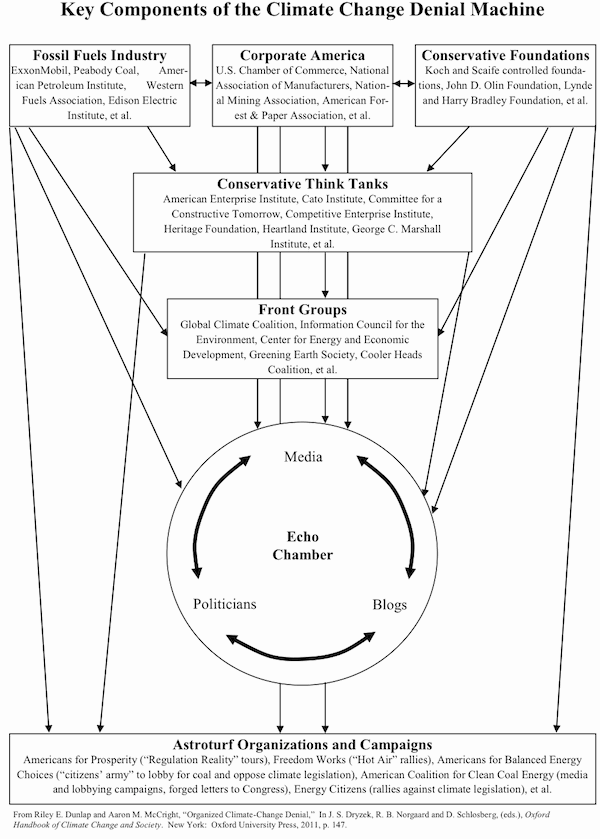
Very useful. Dunlap has been writing important things about environmental politics since I was two, and I am seriously old now… The only thing that’s missing (and I hope to add to the literature on this) is the role of the state. There was a delirious and delicious counter to this graph, by the way, from the chap over at “Australian Climate Madness”
The Cohen piece, the transcript of a Radio National (Australia) piece from 2011 was good.- stuff about ‘persona management’ software that allows companies and the military to hire one intellectual slave for every ten or so sock-puppets that they can put out on the informational battlefield. I came to it because I was hoping there’d be more specifics to back up this claim –
Hagar Cohen: Ravi Prasad explains the appeal of astroturfing.
Ravi Prasad: Well, it’s clearly highly effective. Public debate in Australia has been shaped in a profound way by astroturfing. If you look at the debate around the carbon tax, the debate around mining supertax, and the public debate around asylum seekers, the public debates in these major areas of policy are being shaped in meaningful ways by astroturfing.
But no dice.
Dunlap and Jacques do a lovely update of a previous work on climate change denial books and conservative think tanks. They find that there is a growing trend of self-published stuff. I would quibble with their Australian data, but the basic finding – that books are “clearly a vital weapon in the conservative movement’s war on climate science, and one of the key means by which it diffuses climate change denial throughout American society and into other nations” (p.15) – is solid.
Last up, Rodrik. I don’t know her field well enough, but she clearly has a very good grasp on her field.
Abstract goes as follows –
The contemporary approach to political economy is built around vested interests ‐‐ elites,lobbies, and rent‐seeking groups which get their way at the expense of the general public. The role of ideas in shaping those interests is typically ignored or downplayed. Yet each of the three components of the standard optimization problem in political economy – preferences, constraints, and choice variables – rely on an implicit set of ideas. Once the manner in which ideas enter these frameworks is made explicit, a much richer and more convincing set of results can be obtained. In particular, new ideas about policy—or policy entrepreneurship—can exert an independent effect on equilibrium outcomes even in the absence of changes in the configuration of political power.
For after the thesis, this which probably touches on ‘significant life experiences’ (how people become who they become)
More recently there has been some work, both at the macro and micro level, that looks at the endogenous determination of ideologies: see, for example, Alesina, Cozzi, and Mantovan (2012), Della Vigna and Kaplan (2007) and Yanagizawa‐Drott (2012) on the formation of political preferences through exposure to societal outcomes, media, or early childhood experiences.
p.6
nice concepts
Mancur Olson’s stationary bandits-
From wikipedia – Olson argued that under anarchy, a “roving bandit” only has the incentive to steal and destroy, whilst a “stationary bandit”—a tyrant—has an incentive to encourage some degree of economic success as he expects to remain in power long enough to benefit from that success. A stationary bandit thereby begins to take on the governmental function of protecting citizens and their property against roving bandits. In the move from roving to stationary bandits, Olson sees the seeds of civilization, paving the way, eventually for democracy, which by giving power to those who align with the wishes of the population, improves incentives for good government.[5]
Stackelberg leaders
From wikipedia – The Stackelberg leadership model is a strategic game in economics in which the leader firm moves first and then the follower firms move sequentially. It is named after the German economist Heinrich Freiherr von Stackelberg who published Market Structure and Equilibrium (Marktform und Gleichgewicht) in 1934 which described the model.
In game theory terms, the players of this game are a leader and a follower and they compete on quantity. The Stackelberg leader is sometimes referred to as the Market Leader.
Junkers and “Iron and Rye” coalition
This on South Africa and the transition to ‘democracy’
Nelson Mandela was keenly aware of the problem: “Especially in the first few years of the democratic government,” he said in 1991 (as quoted in Inman and Rubinfeld 2012, p. 784) , “we may have to do something to show that the system has got an inbuilt mechanism which makes it impossible for one group to suppress the other.” In the run‐up to the democratic transition of 1994, South Africa’s federal institutions were specifically designed to prevent the expropriation of the rich white minority by the poor black majority. Two key provisions were critical. First, critical redistributive services were left in the hands of provincial authorities.
Second, borders ensured at least one important province (Western Cape) would remain in the hands of the white minority. Inman and Rubinfeld (2012) argue these two arrangements together created a “hostage game” in which the incentives of a black national government to tax the white elites were moderated by the implicit threat of the local authorities in the Western Cape to respond by reducing service provision to the blacks in their province. Creative manipulation of the rules enabled both a political transition and a movement closer to the efficiency frontier.
p.19-20
Book for the thesis-
In their recent book, Leighton and López (2013) place special emphasis on political entrepreneurship in making policy reform possible. For new ideas to overcome vested interests, they write, it must be the case that “entrepreneurs notice and exploit those loose spots in the structure of ideas, institutions, and incentives” (p. 134).
And this is good-
Political incumbents may be deterred from experimentation because they will bear the full cost of failed policy experiments, but will share the rents resulting from any successes with potential challengers who act as copy cats.
p.23-4
Reminds me of JFK quoteVictory has a thousand fathers but failure is an orphan
And how ideas may emerge – from liminal spaces –
For example, the idea for dual‐track policies in China arose not from the planners themselves, but from black markets in the Chinese countryside where farmers sold grain illegally. Planners were simply wise enough to understand that these markets‐at‐the‐margin enriched farmers without harming the state, as long as the plan quotas themselves were enforced, and then to build public policy on that understanding.
p.24
And stuff I may need to read
Acemoglu, Daron, and James A. Robinson, “Economics versus Politics: Pitfalls of Policy Advice,” NBER Working Paper 18921, March 2013 (forthcoming in Journal of Economic Perspectives).
Beland, Daniel, and Robert Henry Cox, Ideas and Politics in Social Science Research, Oxford University Press, 2011.
Laffont, Jean‐Jacques and Jean Tirole, “The Politics of Government Decision Making: A Theory of Regulatory Capture,” Quarterly Journal of Economics, 106, 1089–1127, 1991.
Leighton, Wayne, and López, Edward. Madmen, Intellectuals, and Academic Scribblers: The Economic Engine of Political Change, Stanford University Press, Stanford, CA 2013.
 marchudson.net
Leave a comment