
Here’s 3 quotations about energy provision. They’re from 1973, 2001 and 2010. Skim, don’t ponder. I’ve put the relevant bits in bold. The tl;dr is that politicians like Big Numbers (duh).
“Project Independence was an initiative announced by U.S. President Richard Nixon on November 7, 1973, in reaction to the OPEC oil embargo and the resulting 1973 oil crisis. Recalling the Manhattan Project, the stated goal of Project Independence was to achieve energy self-sufficiency for the United States by 1980 through a national commitment to energy conservation and development of alternative sources of energy. Nixon declared that American science, technology and industry could free America from dependence on imported oil (energy independence). He called for the construction of 1,000 nuclear power plants by the year 2000.”
and
“For the electricity we need, we must be ambitious as well. Transmission grids stand in need of repair and upgrading and expansion. The demand for electricity is vast, but it also varies from place to place and from season to season. An expanded grid system would allow us to meet demand as it arises, sending power where it’s needed from where it’s not. If we put these connections in place, we’ll go a long way toward avoiding future blackouts.
“But that will only work, of course, if we are generating enough power in the first place. Over the next 20 years, just meeting projected demand will require between 1,300 and 1,900 new power plants. The low estimate is 1,300 new plants; the high estimate, 1,900 new plants. That averages out to more than one new power plant per week every week for the next 20 years.”
Vice President Dick Cheney, April 30, 2001”
Annual Meeting of the Associated Press,Royal York Hotel, Toronto, Ontario
and finally
“With reference to an energy scenario featuring high levels of global coal use, the International Energy Agency CCS Roadmap recommends an ambitious roll-out in which 100 CCS projects are operational by 2020, rising to 3,400 by 2050 (IEA 2010).”
Mander, S., Gough, C., Wood, R., Ashworth, P. and Dowd, A-M. (2013) New energy technologies in the media. A case study of carbon capture and storage pp.225-6. In Roberts, T., Upham, P., Mander, S., McLaclan, C., Boucher, P., Gough, C. and Abi Ghanem, D. (eds) (2013) Low Carbon Energy Controversies. London: Routledge.
Geroge Monbiot makes a similar argument about the attraction of new extractive industries. You get to pose in a hard-hat and be, well, thrusting. And there’s the whiff of technophilia there, far sexier than insulating houses (which can end badly – see the Australian Governments pink bats experience.)
“So we miss part of the story when we imagine it’s just about the money. It’s true that industrial lobbying often defeats a rational assessment of our options, especially, perhaps, when Lynton Crosby has the prime minister’s ear. But cultural and psychological factors can be just as important. Supporting shale gas rather than the alternatives means strutting around with a stiff back and jutting jaw, meeting real men who do real, dirty things, shaking hands and slapping backs, talking about barrels and therms and rigs and wells and pipelines. It’s about these weird, detached, calculating, soft-skinned people becoming, for a while, one of the boys.”
George Montbiot, “What is behind this fracking mania? Unbridled machismo” Guardian, August 19th 2013
One helpful way to think about this is via “hype cycles”.
Now, that classic Simpsons episode “Marge versus the Monorail” is great, but it will only get you so far. You need to clock this.
Hype Cycles, as developed by the IT research and advisory firm Gartner.

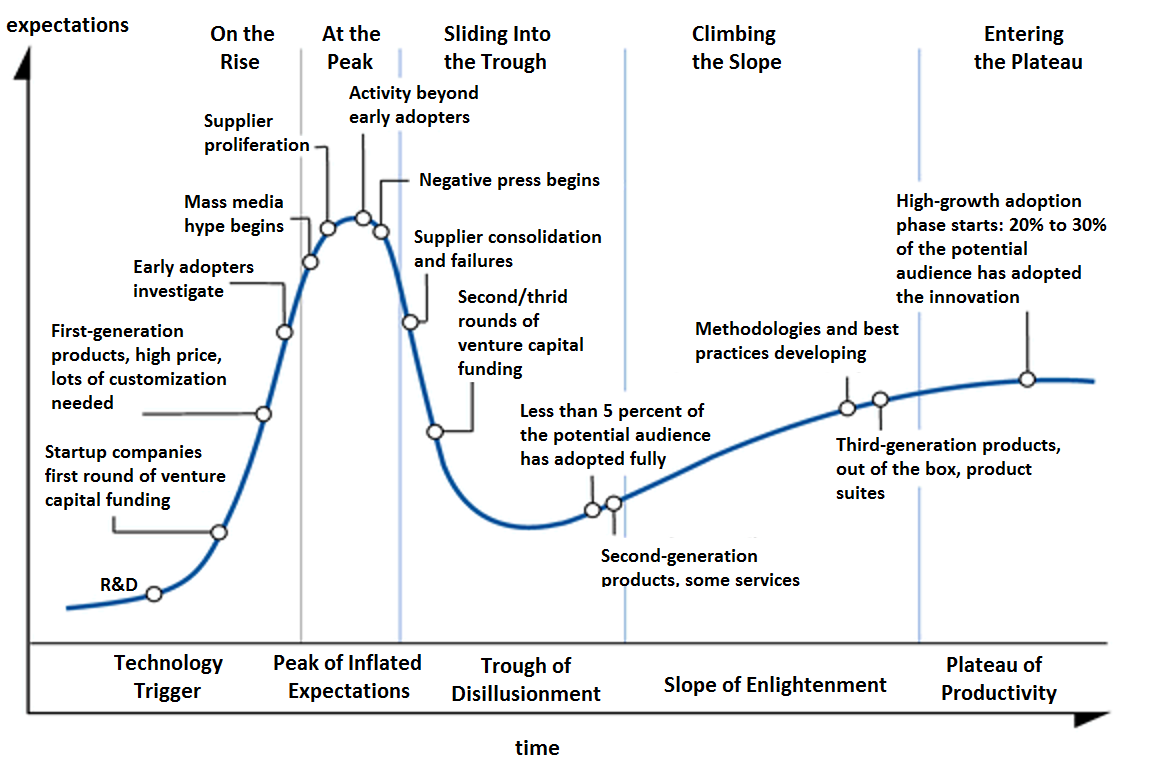
There are criticisms of the theory of hype cycles, but rather than cut and paste a slab more of wikipedia, I’ll give the final word to an anonymous UK journalist, interviewed in Mander et al. (2013, p. 231) about Carbon Capture and Storage;
“[It’s] really interesting over the last five to six years is as far as I can see, there has been no improvement or demonstration of the technology at all and yet the idea has moved from the fringes to very much in the main stream.”
 marchudson.net
Leave a comment